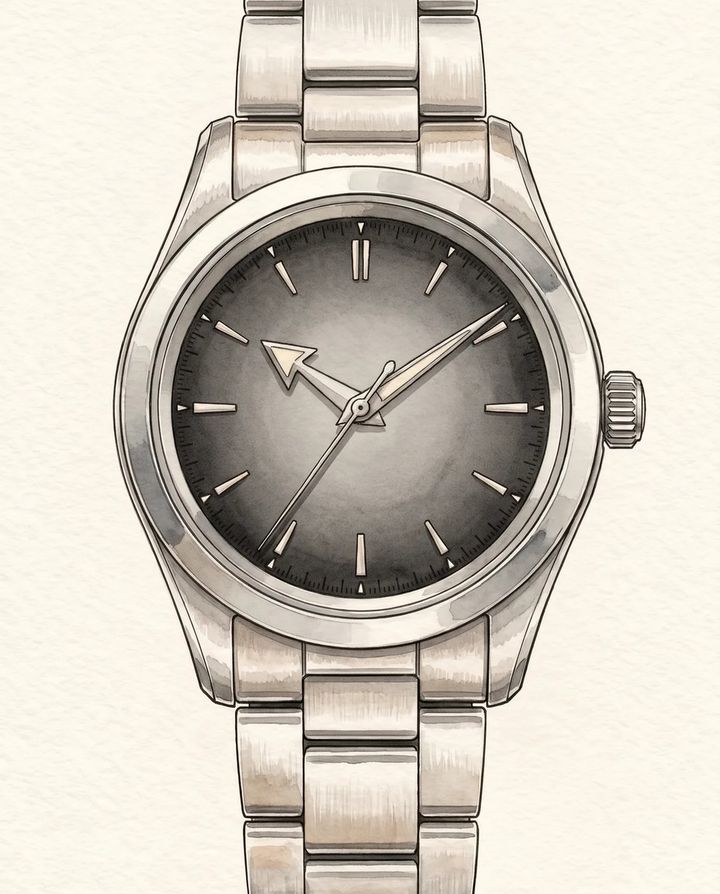
This page covers all four generations, because a pre-owned buyer is usually choosing between them. For the Seamaster that does go diving, see our page on the Seamaster Diver 300M.
1957: CK2914, the one in the iron box
Omega introduced three professional watches in 1957: the Speedmaster CK2915, the Seamaster 300 CK2913 and the Railmaster CK29143,7. The Railmaster was for scientists, engineers and railway staff who worked near electric currents and strong magnetic fields6,18. Fratello calls it Omega's answer to the Rolex Milgauss 6541 of 1954 and the IWC Ingenieur 666 of 19556.
The protection was the case itself. The 38 mm case had a stainless outer case and an inner shield that worked as a Faraday cage, plus a 1 mm thick dial, and it was said to resist 1,000 gauss6. Monochrome and Fratello both say most antimagnetic watches of the time managed about 603,5. Inside were hand-wound movements: calibre 284 at first, then the 285 and 286, across six versions known as CK2914-1 to CK2914-66. Omega used Broad Arrow, dauphine, baton and leaf hands on it6.
It was the least successful of the three3,18. Fratello and SwissWatchExpo put its end in 1963, six years after it began6,8,18. Among the special versions, Fratello singles out the Railmasters made for the Pakistani and Peruvian air forces, marked P.A.F. and F.A.P.18.
2003 to 2012: the Aqua Terra years
Omega brought the name back in 2003, in the case of the Seamaster Aqua Terra, with a black no-date dial, Arabic numerals at 3, 6, 9 and 12, arrow-tipped hands and 150 metres of water resistance3,13. Omega's own pages give three automatic sizes on the bracelet: 36.2 mm (ref. 2504.52.00), 39.2 mm (ref. 2503.52.00) and 41 mm (ref. 2502.52.00), each with a transparent back15,16,17. All three have calibre 2403, a self-winding co-axial chronometer with 44 hours of reserve15,16,17. The Grail Watch Wiki describes the 2403 as the no-date version of calibre 2500, Omega's first co-axial calibre, which was based on Omega's calibre 1120, itself derived from the ETA 2892-A2, and introduced in 199919.
There was also a 49 mm watch with a pocket-watch movement, and the sources do not agree on when it arrived or what was in it (see below)5,8,13.
Fratello's Michael Stockton wrote in 2016 that the 39 mm was the one collectors wanted, and that the 2003 watch paid little attention to its ancestor's antimagnetic purpose13. We found no magnetic figure on Omega's pages for the 2403 watches15,16,17. Stockton links the gap to the Aqua Terra rated beyond 15,000 gauss that Omega announced in 201313,20. The Railmaster was dropped in or around 20125,8,13.
2017: the Trilogy and the 40 mm watch
For the 60th anniversary of the 1957 watches, Omega made three limited editions at Baselworld 2017, each of 3,557 pieces, plus a box with all three limited to 5577,21. Monochrome says Omega scanned the originals digitally to get the proportions7. The Railmaster, ref. 220.10.38.20.01.002, is 38 mm, 12.70 mm thick, 48.00 mm lug to lug, with 19 mm between the lugs, a black tropical dial and calibre 880614. It is water-resistant to only 60 metres14. The original was hand-wound, and the reissue is not; Fratello's review says that is the one criticism die-hard fans will have18.
At the same fair Omega showed a second, unlimited Railmaster that was neither in the press release nor on its website22,23. It is 40 mm, 12.65 mm thick, 47.00 mm lug to lug, with a vertically brushed steel dial, a screw-in crown, a closed back, 150 metres and the same calibre 880612,23. Omega's own pages give the black ref. 220.10.40.20.01.001, a grey 220.10.40.20.06.001 and a «blue jeans» 220.10.40.20.03.001, with strap versions under 220.1212,24,25,26. The denim dial arrived in 201827. Omega presents the black watch as an update of the 1957 original, which it says was made for railway staff and others who worked near electrical fields12.
By 17 November 2024 Omega's US page for the black 40 mm said it was no longer available11. Monochrome called it recently discontinued in May 20253.
2025: back to 38 mm
In May 2025 Omega replaced it with two 38 mm watches: one with central seconds and calibre 8806, one with small seconds and calibre 88043,5. Monochrome calls them a Railmaster version of the 38 mm Aqua Terra: brushed and polished instead of fully brushed, with a sapphire back, gradient dials and the Broad Arrow hands of 19573. Omega gives both 55 hours of reserve and 15,000 gauss1,2.
What «antimagnetic» means, in gauss
Gauss measures the strength of a magnetic field; 15,000 gauss is 1.5 tesla20. Under ISO 764, a watch may be called magnetic-resistant if it survives a field of 4,800 amperes per metre and still keeps within 30 seconds a day of its earlier rate20. That works out to about 60 gauss, which is also what Monochrome and Fratello say most antimagnetic watches managed in the 1950s3,5. The CK2914's 1,000 gauss was therefore more than 16 times that, and the current 15,000 gauss is fifteen times the CK29143,5,6.
The method changed completely. The 1957 watch kept the field out with an iron cage6,8. The modern watches let it in, and rely on a silicon balance spring and other non-ferrous materials in the movement itself4,5,20. Bob's Watches says that is what lets the 2025 watch have a glass back28.
To earn the Master Chronometer name, Omega says each movement, and then the cased watch, is put in a 15,000 gauss field, and the watch must then run within 0/+5 to 0/+7 seconds a day, depending on calibre size; Omega's page for this watch gives 0 to +61,4. Omega began the programme in 20154.
Does it matter to an ordinary owner? Omega says yes: its Master Chronometer page lists phones, handbag clasps, laptops, MRI scanners, induction cookers and automatic doors among the everyday things that magnetise a watch4. Fratello's Stockton says most people are not truly dealing with fields that can affect a watch13. Neither source gives a measured field strength for a phone or a clasp, so we do not print one. What we can say is that a 1950s-standard watch was built for about 60 gauss and a current Railmaster is tested at 15,0003,4.
What it cost, and what it costs
Omega publishes its list prices on its own site. The figures below are from archived copies of those pages, read on 2 November 2026, and from the press: launch reports, and Monochrome for the euro price in 2022. All are on the steel bracelet.
Read across, the US price of the black 40 mm rose 14 per cent from November 2018 to its last archived price in April 202429,30. The grey 38 mm rose about 7 per cent between the copies of July and November 2025, and was unchanged in September 20269,10,31.
We do not show third-party market prices, so there is no pre-owned figure on this page.
Buying one pre-owned
The 40 mm is a 15,000 gauss Railmaster with a closed back12,27. The 2025 watch shows its movement through a sapphire back1. The Trilogy watch is the one to buy if you want the 1957 shape and can live with 60 metres14.
On a 2003 watch, look for service history. Fratello notes that early calibre 2500s had teething problems and that the frequency was lowered from 28,800 to 25,200 vibrations an hour in later versions13. On any watch from 2017 on, ask for the Master Chronometer card and check it online32.
We found no production numbers for any Railmaster except the 3,557 Trilogy watches7,14.
The dubious part
The 1957 Railmaster hid its movement inside an iron box, away from the generators6,8. The 2025 one shows it off through a sapphire window1. Somewhere in between, the generators stopped being the problem, and the handbag became it4.