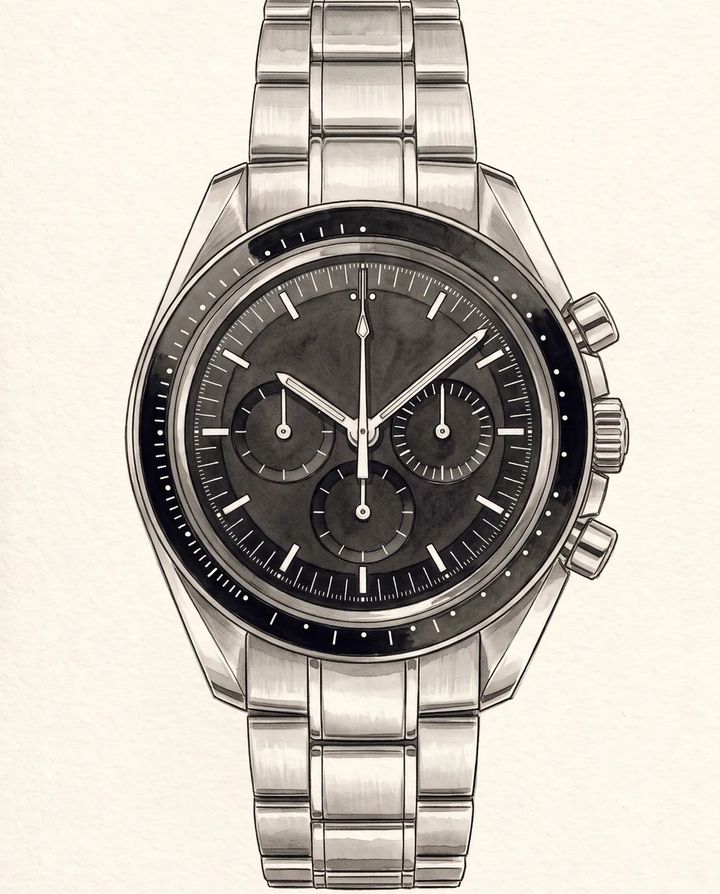
Why it is called the Moonwatch
Omega introduced the Speedmaster in 1957 as a sport and racing chronograph16. Wally Schirra wore his own on Mercury-Atlas 8 in October 1962, when watches were not yet part of an astronaut's kit9,15,16. In September 1964 NASA's flight crew director asked for a durable chronograph for the Gemini and Apollo crews; NASA engineer James Ragan sent a request to about ten makers, and four answered15. Hamilton sent a pocket watch and was out15. Rolex, Longines-Wittnauer and Omega went through eleven tests, from 93 °C in a partial vacuum to shocks of 40 g15. Fratello, which has seen the test documents in Omega's archive, says the Rolex stopped in the humidity test and the Longines crystal warped in the heat15. The Speedmaster 105.003 passed15.
When exactly it was qualified depends on whom you ask; see Where the sources disagree below. Gus Grissom and John Young wore Speedmasters on Gemini 3 on 23 March 1965, and Ed White wore the watch on the first American spacewalk in June that year15,16.
On Apollo 11, Neil Armstrong left his Speedmaster inside the lunar module as a backup, because the module's electronic timer had failed8,16. Aldrin wore his, which made it the first watch worn on the Moon8,16. It was lost in transit around 1971, on its way to the Smithsonian, and its whereabouts are unknown8. Armstrong's is in the National Air and Space Museum18. After Apollo 11, says Omega, the Speedmaster became known as the Moonwatch; it went on all six lunar landings2,7. NASA qualified the 861-powered version again in 1978 for the Space Shuttle9,11.
From 861 to 3861: telling the generations apart
The watches worn on the Moon were the 105.012 and the 145.012, both with calibre 32114,16; Fratello adds Gene Cernan's older 105.003, worn on Apollo 1715. Most Speedmaster Professionals since 1968 have run on the 861 family, which replaced the 321's column wheel with a cam and raised the beat from 18,000 to 21,600 vibrations per hour; Omega brought the 321 back in 201914,16.
Years are the dealers' and collectors', not Omega's, and watches made around a change can mix both rows. Fratello mentions 3570.50s with tritium dials and even a few with the 861 inside, which collectors call transitional11.
The 145.022. Fratello's guide warns that the suffix on the inside of the case back gives the year the case back was made, not the watch; the movement number dates the watch14. The early case backs show only a seahorse and «Speedmaster». Engravings about the Moon followed in several versions that were used side by side; Monochrome dates the first to 1971, Fratello to 19709,14.
The 3570.50 and the 311.30.42.30.01.005. Fratello and Monochrome call them essentially the same watch4,11. The later one got screws instead of friction pins in the bracelet and a bigger box; case and movement did not change11. The 1861 has 18 jewels, a Swiss lever escapement, a synthetic brake for the chronograph and about 48 hours of reserve, and it was never chronometer-certified4. The sapphire versions used the 1863, the same movement with better finishing and a metal brake4,11.
The 3861. Monochrome's review of January 2021 says that almost every part changed, while the watch still looks like a Speedmaster4. The case is thinner, the bezel went back to the dot over 90, the dial got back its step after 46 years of flat dials, the seconds hand got a teardrop counterweight, and the bracelet now tapers to 15 mm4. Omega says the design draws on the fourth-generation Speedmaster, the one worn on the Moon2,10.
Hesalite or sapphire
Hesalite is the domed acrylic crystal the first Speedmaster had in 195716. Bob's Watches calls it shatter-resistant, and sapphire scratchproof19. Since 2021 the two versions differ in more than the glass. The Hesalite version has a solid back with the NASA engravings, a printed logo and a fully brushed bracelet; the sapphire version has a display back, an applied logo and polished centre links4. The sapphire version is also the thinner of the two1,2. The movement is the same 3861, finished the same way, which was not true of the 1861 and 18634.
Fratello's Robert-Jan Broer would take the Hesalite11. Monochrome's reviewer leaned towards sapphire for daily wear4. Our view: the Hesalite is the Moonwatch, and the sapphire is the Moonwatch for people who own a desk with a hard edge. The difference in Omega's US list price was USD 850 in 2021 and USD 1,200 in September 202612,13,17,20.
Inside: calibre 3861 and the Master Chronometer test
The 3861 first appeared in 2019, in the Apollo 11 50th anniversary Speedmasters, and reached the standard Moonwatch in January 20213,4. It keeps the old cam and horizontal clutch, and adds the co-axial escapement, a silicon balance spring and non-magnetic escapement parts4,10. It is the first hand-wound Speedmaster movement with a co-axial escapement3.
Master Chronometer means the watch is tested twice. The movement is first tested as a chronometer to ISO 3159, and then the cased watch goes through eight further tests set by METAS: function and precision in a field of 15,000 gauss, precision in six positions and from day to day, precision at low power reserve, power reserve, and water resistance5. For the 3861 the accuracy limit is 0 to +5 seconds a day3,4. The 1861 had no chronometer certificate at all4. In practice the old watch was a tool that was assumed to be accurate, and the new one is a tool with paperwork.
What it cost, and what it costs
These are Omega's own US list prices for the two steel bracelet versions, read from archived copies of omegawatches.com, set beside the euro list prices that Monochrome and Fratello published3,11,12,13,17,20,21,22,23,24,25,26,27.
In a little under six years the US price of the Hesalite version rose about 24 per cent and the sapphire version about 2612,13,17,20. The gap between them grew from USD 850 to USD 1,200.
The 1861 watch cost less new. Fratello puts the last list price of the 311.30.42.30.01.005 just under EUR 5,000; Monochrome says the 3861 cost about EUR 1,300 more than the reference it replaced, and SJX put the increase at about a quarter3,10,11.
We do not show third-party market prices, so there is no pre-owned figure on this page.
Buying one pre-owned
The choice is mostly between the 3861 and the 1861. Fratello's Robert-Jan Broer says he would buy a 3570.50 in good condition for himself, and that condition matters more than box and papers if you mean to wear it11. For the 145.022, Fratello says many bezels with the dot over 90 were swapped years ago, when nobody cared; a vintage watch should be judged part by part14.
Service is part of the price. Fratello reported in 2025 that Omega charged EUR 950 to overhaul a 3570.50, with a two-year warranty afterwards11. A claim of a recent service without paperwork, says Fratello, should be treated as no service11. Omega gives the new 3861 watches a five-year warranty3.
It is water-resistant to 50 metres, enough for a swim, not for diving1,11. If you are weighing it against the other famous steel chronograph, our Daytona pages have the Rolex side, and the watch index has the rest. The general rules for buying a watch with a case you cannot open are the same as for a Rolex; our guide to telling a real Rolex explains them, and how we verify explains how we check our own numbers.
Omega does not publish how many Moonwatches it has made of any reference. We found no figure.
The dubious part
Most of the case backs on this page say THE FIRST WATCH WORN ON THE MOON4,9. None of these references has been there14. The first one worn there, Aldrin's, was lost in transit around 19718. The engraving has had a better career than the watch.