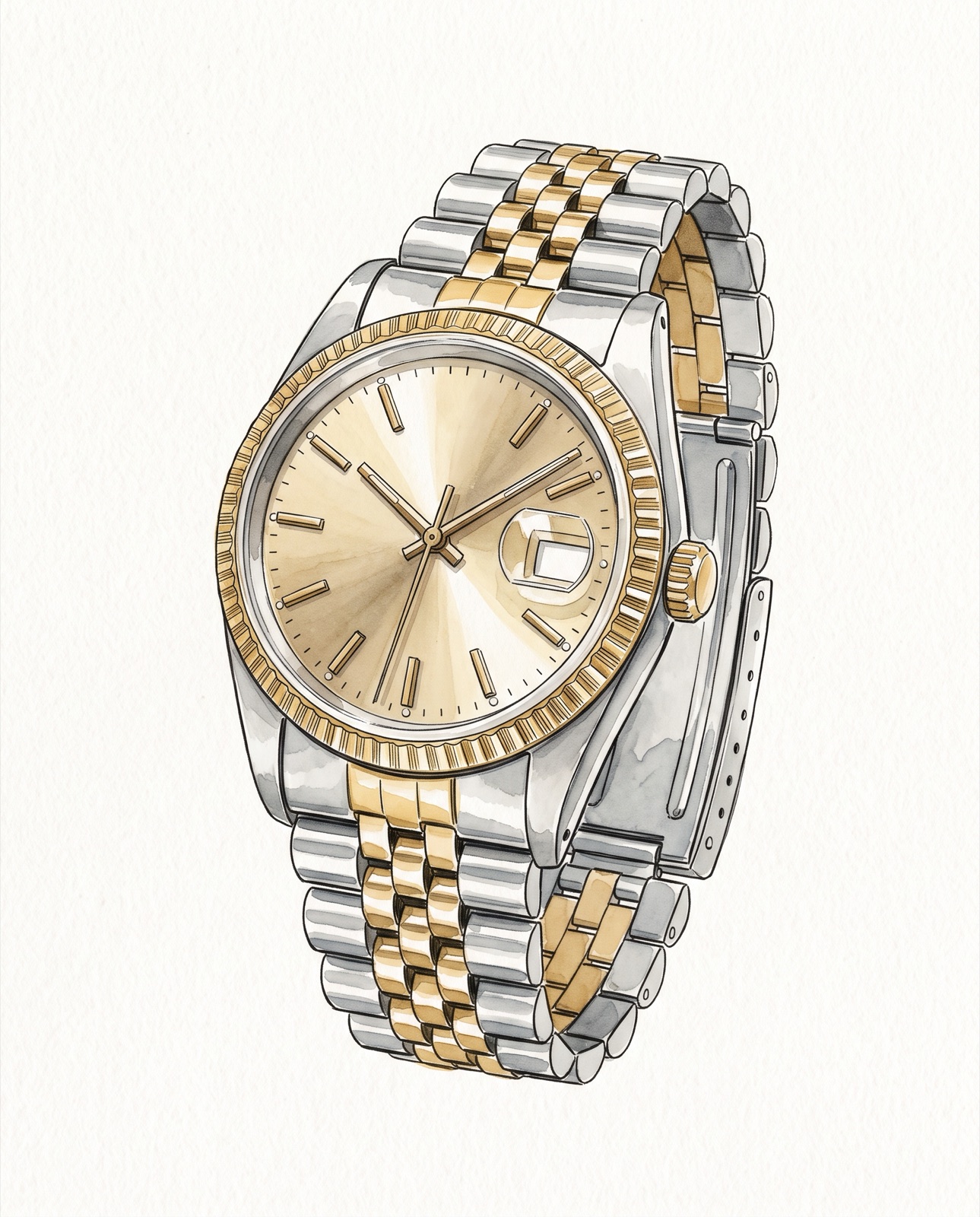
Plenty of thirty-year-old watches live in drawers. The 16233 lives on the second-hand market, in large numbers1. It is the two-tone Datejust Rolex made from 1988 to about 2005: a 36 mm steel case with a fluted yellow gold bezel, a sapphire crystal and calibre 31351,11,12.
What follows is where it sits in the family, what changed during its seventeen years, what it cost new, what it is asked for now and how to tell a sound one from the rest.
Where the 16233 sits
The Datejust arrived in 1945 as ref. 446718,23. By Rolex's own account it was the first self-winding chronometer wristwatch to show the date in a window on the dial23,24. The Cyclops lens followed in 195318,25.
In 1977 the two-tone 16013 brought calibre 3035 and a quickset date, so the date could be set on its own with the crown11,18,26. In 1988 the 16233 replaced it with calibre 3135 and a sapphire crystal1,11.
Around 2004 or 2005 the six-digit 116233 took over, with solid links and broader polished lugs5,15,27. In 2018 the 126233 replaced that, with calibre 32355,15. Four generations, one silhouette. You have to know where to look.
What 1988 brought
Two things, both practical. The first was the crystal. The 16013 had a domed acrylic crystal; the 16233 has a flat sapphire one, which resists scratches far better1,12. BeckerTime goes further and says the 16013 had already moved to sapphire by the end of its production in 1988, while Everest Bands says every 160xx has acrylic12,26. Either way, the 16233 is where sapphire became standard1,11.
The second was the movement. Calibre 3135 has 31 jewels, runs at 28,800 vibrations an hour and holds about 48 hours of power reserve6,7. It replaced calibre 3035 in the Datejust7 and went on to power the Datejust for more than two decades4. Any competent watchmaker can service it, and parts are plentiful1.
One thing a 16233 almost certainly did not have is the blue Parachrom hairspring. Caliber Corner first sees it in the 3135 around 2007 or 2008, in the Deepsea and the ceramic Submariner, and stresses that there is no fixed cut-off; Grail Watch dates it to 20096,7. Both are after the 16233's usual end date. One dealer history says otherwise; see «Where the sources disagree» below.
Seventeen years of small changes
A reference made for seventeen years does not stay the same, and the 16233 changed in ways that now help to date a watch. The first is the lugs. Earlier cases have holes drilled right through the lugs, which makes changing a strap easy. Rolex phased these out in the mid-1990s, according to BeckerTime10, and later 16233s have smooth lugs10,12. No exact year is published.
The second is the lume. Early dials use tritium, which glows on its own and often ages to a warm cream colour1,8. Rolex moved to Luminova around 1998 and to Super-LumiNova around 20008,9,10. Tritium dials say so in small print: «T Swiss T» or «Swiss T<25»8.
The third is the crystal. From the early 2000s Rolex laser-etched a tiny crown into the sapphire at six o'clock, so only the last few years of 16233s left the factory with one1,21,22.
The dials changed constantly. Rolex offered the 16233 in champagne, white, silver, blue, black and slate, with applied gold baton markers, Roman or Arabic numerals or factory diamonds, and textured finishes such as the jubilee pattern with its repeating Rolex logo1,4. NexChrono calls the champagne dial with applied gold markers the quintessential two-tone Datejust look1.
The 16233 against the 116233
The 116233 is the reference buyers and dealers compare it with directly2,5. Side by side, the 16233 has slimmer brushed lugs and a lighter bracelet with hollow end links and hollow centre links. The 116233 has thicker polished lugs, solid end links and solid centre links5,10,15. On the Jubilee, the 116233 also has a hidden Crownclasp15.
The ring under the crystal tells them apart too. The 16233's rehaut is plain, with the serial number between the lugs4,21. The engraved ROLEX rehaut arrived during the 116233 generation, and not on every early 11623310,21. Both run calibre 3135 behind a sapphire crystal5.
What it cost then, what it costs now
The 16233 has been out of production for about twenty years, and we found no Rolex price list for it. The best record we found is a US retail price table that a Rolex retailer handed a collector in 2005, published on Minus4Plus613. It is a dealer's handout, not a Rolex document, and for this line it names a single reference, the 116233, which was current when the handout was given.
For the two-tone Datejust on a Jubilee it gives USD 4,350 in February 1989, USD 4,500 in September 1992, USD 5,300 in September 1996 and USD 5,775 in February 200413. That is a rise of 32.8 per cent over those fifteen years. By February 2005 the figure was USD 7,325. The table does not say whether that is still the 16233 or already the heavier 116233, which arrived around then5,13,27.
Second-hand, we can only measure asking prices. We took the median of the first page of Chrono24's 16233 listings in archived copies14,16,17,28,29. In the year from September 2024 to September 2025 it rose from USD 6,500 to USD 7,452, about 14.6 per cent14,17. In the nine and a half months before that it fell from USD 7,200 in December 2023 to USD 6,500, about 9.7 per cent16,17. The two windows point in opposite directions. Across the whole stretch, December 2023 to September 2025, the median rose about 3.5 per cent.
Asking prices are not sale prices, and each first page mixes dials, conditions and watches with and without papers. Read the line as a direction, not a valuation. For scale: on 14 October 2026 Rolex listed the current 126233 at USD 15,900 on a Jubilee with a plain dial30.
Buying one second-hand
A 16233 may now be more than thirty years old, so condition matters more than on a newer watch. Start with the bracelet. Stretch is the most common problem on an old Datejust, and a two-tone replacement is expensive because of the gold1. Then the dial: a refinished dial can look attractive but sharply reduces value1. Then the case: heavy polishing rounds and thins the lugs1,15.
Match the serial between the lugs to any papers, and make sure everything on the watch belongs to its period: lug holes or not, tritium or Luminova, a crown in the crystal or not4,8,10. NexChrono warns that the 16233 is often faked and sometimes assembled from mixed parts1.
Rolex recommends servicing its watches about every ten years, depending on the model and use31. Ask when the last service was, and by whom.
Nobody can tell you how many 16233s Rolex made. Rolex publishes no production figures, and the analyst estimates that exist cover the whole brand, not single references32,33.
The dubious part
The 16233 is usually sold as the vintage Datejust for people who don't want a vintage watch: sapphire, quickset, a movement any watchmaker can service. The most vintage thing about most of them is the bracelet.