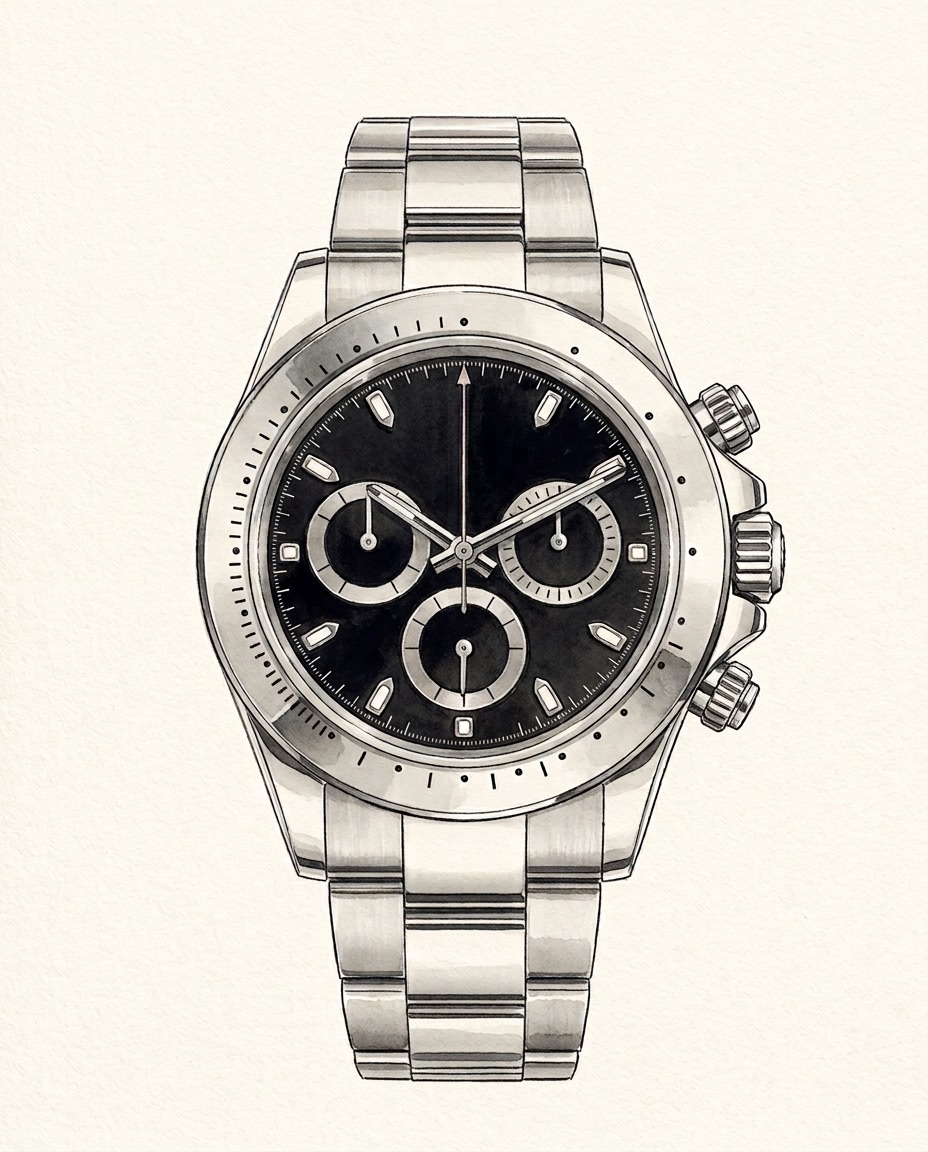
Rolex built the Cosmograph for racing drivers, with a bezel for working out average speeds up to 400 kilometres or miles an hour1. The 116520 is the steel version from 2000 to 2016: the first Daytona with a movement Rolex made itself, and the last steel one with a steel bezel. Every steel Daytona since has a black ceramic bezel5,9,12,14.
From the Zenith Daytona to calibre 4130
Rolex launched the Cosmograph in 19638,12. The first self-winding Daytona, the 16520 of 1988, used a heavily modified version of Zenith's El Primero movement5,6,10. aBlogtoWatch, Monochrome and Wikipedia have the 16520 end in 20006,10,12; according to Mazzariol's study it went out of production in 200111.
In 2000 Rolex replaced it with calibre 4130, a self-winding chronograph movement it had developed and made itself1,12,23. It came with a new generation of six-digit references, and the steel one was the 1165205,12.
From the outside the change was easy to miss. The case is 40 mm, as before, and the bezel is still engraved steel1,5. The give-away is on the dial: the small seconds moved from 9 o'clock to 6, and the counters at 3 and 9 sit slightly above the centre line5,12. The bracelet changed too, from hollow to solid end links and centre links, with a sturdier clasp5.
When it was made
The start is settled. Mazzariol shows a Japanese booklet dated 2000 and a guarantee for a gold sister model from the same year, and Bob's, aBlogtoWatch and Monochrome all give 20005,6,10,11.
The end is settled as a year, 2016, but not as a story. Bob's, aBlogtoWatch, Gray & Sons and Mazzariol all end production in 2016, and Gray & Sons, aBlogtoWatch and Luxury of Watches say the 116500LN replaced it5,9,10,11,19. At Baselworld in March 2016, though, SJX reported Rolex's line that the ceramic model was an addition and the 116520 would continue13.
Rolex's website settles the timing, if not the intention: the Internet Archive's index shows its pages for the two 116520 model numbers answering until May and June 2016 and redirecting from June and July2. We found no production figure for the 116520, from Rolex or anyone else.
The movement
Calibre 4130 is a self-winding chronograph with a column wheel and a vertical clutch1,6. It runs at 28,800 vibrations an hour and holds about 72 hours of power reserve, up from about 54 hours in the Zenith-based calibre 40306,7. Rolex says its architecture uses far fewer components than a standard chronograph1. The total is disputed: aBlogtoWatch and Luxury Bazaar say 201 parts, Mazzariol, Time and Watches and Timeless Vintage say 2903,7,11,22,23.
Rolex calls the 4130 the first movement with a Parachrom hairspring8. Mazzariol shows a document placing Parachrom in the 4130 from 2000, in its blue, oxide-coated form from 2005; Chrono24's text and WatchGuys date Parachrom itself to 20054,11,17.
On Rolex's 2013 page the 116520 was a Swiss chronometer tested by COSC1. The tighter standard of −2/+2 seconds a day came with Rolex's redefinition of its Superlative Chronometer in 201524. Bob's and aBlogtoWatch write that the 4130 meets it; WatchGuys says the 116520 predates it3,4,5. We found no Rolex document that settles it for the 116520.
Sixteen years of small changes
Rolex sold the 116520 with a black or a white dial1,4,5. Collectors have since dated a string of small changes, listed in the table below. Stefano Mazzariol's study is the most detailed we found, but it is one collector's work, and the second source we found often differs by a year11,19. Three changes are worth knowing. Some early white dials have turned cream, which the trade calls «Panna»11,19. From about 2010, according to Mazzariol's study, some dials were printed with a gap before the last three letters of «COSMOGRAPH», the so-called APH dial11; WatchGuys and Luxury of Watches describe the variant but give no year4,19. And the last dials, from 2013 or 2014, glow blue with Chromalight instead of green7,11,19.
The 116520 and its successors
In 2016 the 116500LN arrived with the same 40 mm case, the same calibre 4130 and a black Cerachrom bezel; SJX reported it at CHF 11,800 at launch, «marginally more» than the all-steel model13. In 2023 Rolex's fourth Daytona generation followed, with calibre 4131 and the reference 126500LN8,12,25.
On 16 October 2026 the 126500LN listed at USD 16,900 in the US, GBP 14,050 in the UK and EUR 16,200 in Germany14,26,27. The US price was USD 16,000 on 4 November 2025 and USD 16,900 by 13 January 2026, a rise of 5.6 per cent14,28,29.
What it costs
New, the 116520's last US retail price was USD 12,000 according to aBlogtoWatch, citing rolex.com, and USD 12,200 according to Beckertime and Luxury Bazaar3,21,22. We found no archived Rolex page with a price, so we print both. Beckertime puts the 2000 launch price at about USD 6,00021; aBlogtoWatch says the retail price almost doubled between 2000 and 2015, and Mazzariol's study shows a 2002 Rolex price list at EUR 5,944 including VAT10,11.
Second-hand, the median asking price on the first page of Chrono24's 116520 listings was USD 23,346 in February 2026, leaving out Zenith 16520s and modified watches17. The window decides the story. Over twelve months, from February 2025, the median rose 13.9 per cent. Measured from July 2024 it rose 2.0 per cent, because asking prices first fell 10.4 per cent to February 202515,16,17. Counting every listing gives +12.5 and +2.2 per cent. Asking prices are not sale prices.
For sold prices, EveryWatch records three 116520s sold at auction between 25 September and 5 October 2026 at USD 20,790, 22,219 and 22,50020. A fourth, at Sotheby's in Hong Kong, made USD 65,260; the listing does not say what set it apart, so we leave it out of any average20.
The old watch now asks more than the new one lists for. The February 2026 median was 38.1 per cent above the USD 16,900 that Rolex listed for a new 126500LN in January 202617,29. Against its own last retail price, the median is up 91 to 95 per cent, depending on which retail figure you believe3,17,21.
The dubious part
The 116520 is a racing chronograph with a bezel for average speeds up to 400 kilometres an hour1. Its chronograph pushers screw down, so before you can time anything you first have to unscrew them1,4. By the time the stopwatch is ready, most laps are over.
Then there is the price chart. A watch that sold new for about USD 12,000 now asks around USD 23,000, which looks like an investment, until you notice the asking price fell ten per cent between July 2024 and February 20253,15,16,17. Investments that do that are usually called something else.