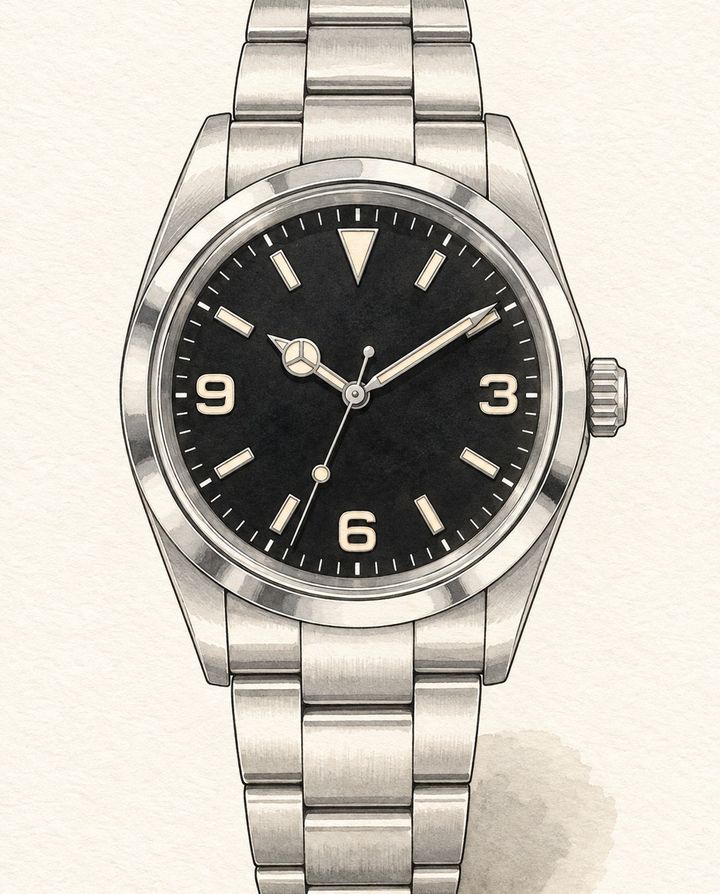
The Explorer is the Rolex with the shortest job description: tell the time, clearly, wherever you are. Ref. 114270 is the version Rolex made from 2001 to 20101,4,12: a 36 mm steel case, a black dial with 3, 6 and 9, no date and a plain bezel2,3,6.
Outwardly it is almost a late 142701,3. What follows is what changed, how to date one, and what Rolex itself says about Everest, which is less than the legend.
Everest: what Rolex says, and what is documented
On 29 May 1953 Edmund Hillary and Tenzing Norgay reached the summit of Everest with a British expedition led by John Hunt19,23. Rolex supplied Oyster Perpetual watches to it, as it had backed Himalayan expeditions since the 1930s15,19,24.
Rolex's own account is careful. Its Explorer page dates the watch to the aftermath of the 1953 ascent and says the British team carried Oyster Perpetuals; it does not say who wore which watch at the top19. In 2007, while the 114270 was in production, the Explorer II page on rolex.com simply gave 1953 as the Explorer's birth year, the same year Everest was first climbed25.
What is documented is less tidy. Hillary wore a Smiths De Luxe, an English watch, on the summit day: the Science Museum Group, which displays it, says so, and Hillary gave it to the Worshipful Company of Clockmakers himself in 195318,23. Smiths supplied 15 watches to the expedition24. According to James Dowling and Jeffrey Hess, authors of a history of Rolex wristwatches, Tenzing wore a Rolex to the summit26. Hodinkee cites a conclusion that a Smiths, not a Rolex, made it to the top, and Fratello calls that highly likely1,24.
Nor was the Rolex on the mountain signed Explorer4,5. Rolex registered the name in January 19531,12. Monochrome and Blackbird identify the Rolex that went with the expedition as a reference 6098, which collectors call a pre-Explorer, and Blackbird says it is believed to have been Tenzing's. Rolex supplied more than one watch, and we name no single reference for the summit5,12,24. A Rolex from the expedition is on display at the Beyer Museum in Zurich1,12. Retellings that send the Explorer itself up the mountain, including one dealer's guide to the 114270, go further than Rolex does7,19.
From the 1016 to the 114270
The Explorer's layout was settled early: black dial, numerals at 3, 6 and 9, a Mercedes hour hand and a 36 mm Oyster case4,12. Which reference counts as the first Explorer is still argued over: the 6150, mostly signed «Precision», or the 6350, the first signed Explorer on every dial1,12,15.
The 1016 carried the line until 1989, with painted numerals and an acrylic crystal1,2,5. The 14270 of 1989 set the modern pattern: sapphire crystal, glossy black dial, applied 3, 6 and 9 in 18 ct white gold and the high-beat calibre 30001,2,3,5. Its lume went from tritium to Luminova and then Super-LumiNova, and its lugs lost their drilled holes1,5,12. Its last version, signed «SWISS MADE», is outwardly the same watch as the 1142701,3.
The 114270 arrived in 20011,2,3,13. Bob's Watches calls it a classic example of Rolex creating a new reference to house a new movement2.
What changed in 2001
Inside, calibre 3130 replaced the 3000. The 3000 had a balance cock and a flat hairspring; the 3130 has a full balance bridge and a Breguet overcoil5,10,12,13 and about 48 hours of power reserve4,10. Whether that was more than before is unclear: Monochrome gives the 3000 42 hours in one article and 48 in another9,12. The sources credit the bridge with more stability and better shock resistance5,10.
Outside, the bracelet gained solid end links, the pieces that meet the case1,2,3,9. The rest stayed: the undrilled lugs of later 14270s, 36 mm, 20 mm between the lugs, the glossy dial with Super-LumiNova and «SWISS MADE», and white gold 3, 6 and 9 that do not glow1,3,4,5,8,12. They are filled with white paint, which in daylight nearly matches the lume on the markers8.
Nine years, one visible change
Rolex did not mark model years, so collectors date a 114270 by its details. The one you can see is the rehaut, the ring between dial and crystal: plain on early watches, engraved with ROLEX and the serial number on late ones1,5,13,14.
When it changed is less certain. Hodinkee says late in production and Blackbird's article says at the very end of the run, while Blackbird's own table starts it in the middle of the Z serial range1,5, which the usual serial charts place in 2006 or 200716. The serials run from K to G, about 2001 to 2010 by the same charts5,16. Two details belong to Rolex in general: a small crown laser-etched into the crystal from about 200227,28,29 and, by one account, a hologram sticker on the case back until 200728.
We found no source describing a change to the dial itself. Rolex announced its blue-glowing Chromalight lume in 200830, but every source we read that names the 114270's lume says Super-LumiNova1,3,9. Among 36 mm Explorers, Chromalight numerals belong to the 1242708,17.
Inside: calibre 3130
Calibre 3130 is the time-only member of Rolex's 3100 family, in effect a 3135 without the date10,11. It runs at 28,800 vibrations an hour with 31 jewels and about 48 hours of power reserve, winds in both directions and stops the seconds hand when the crown is pulled out4,10,11. It also powered the Submariner 14060M and the Air-King 11420010,11.
The sources split on the hairspring. Fratello, Monochrome, BeckerTime and Bob's Watches say the 114270's 3130 has Rolex's Parachrom spring4,7,11,12. Grail Watch says the 3130 had a Nivarox spring and received Parachrom only in 2010, keeping its name10. If Grail Watch is right, most 114270s have a Nivarox spring. We leave it open.
Shock protection is the older Kif system; Rolex's own Paraflex arrived with calibre 3132 in the 2142702,3,10,11. The movement is a COSC chronometer7,11. The −2/+2 seconds a day that BeckerTime quotes is Rolex's Superlative Chronometer standard as redefined in 2015, after the 114270 had gone11,31,32.
What came after
In 2010 the 214270 replaced it as the first Explorer with a 39 mm case1,2,15, with calibre 3132 and the Explorer name moved to the lower half of the dial2,3. Its hands looked short for the larger dial, and collectors say they were the 114270's carried over; Rolex lengthened them and lumed the numerals in 20161,2,3,9,12.
In 2021 the 124270 brought the Explorer back to 36 mm, with calibre 3230 and about 70 hours of power reserve12,15,17. It looks close to the 114270 but is a different watch (see the table below). A 40 mm Explorer, ref. 224270, followed in 202312,15.
What it cost
Rolex no longer makes the 114270, and we found no Rolex list price for it in archived copies of rolex.com, so we show none. We do not show third-party market prices.
For comparison only: on 29 October 2026 Rolex listed the current 36 mm Explorer, ref. 124270, at USD 7,900 in the US, GBP 6,600 in the UK and EUR 7,650 in Germany17,33,34. That is a different watch with a different movement, not a price for the 114270.
Buying one pre-owned
Rolex's position is simple: buy from a jeweller in Rolex's own retail network35. Away from that network, a 114270 is at least sixteen years old, and its details should agree: serial letter, rehaut, crown in the crystal, numerals and bracelet5,16,27. An engraved rehaut on a K, Y or F serial deserves a question; a plain one on an M or V serial can be correct, as the sources disagree on when the engraving began. Bob's Watches also advises checking the case for heavy polishing and the bracelet for stretch7.
Nobody can tell you how many 114270s exist. We found no production figure from Rolex, and the analyst estimates that exist cover the whole brand, not single references20,21.
The dubious part
Rolex is careful not to say who wore which watch on top of Everest19,24. Owners of the 114270 are rarely so careful at dinner parties.