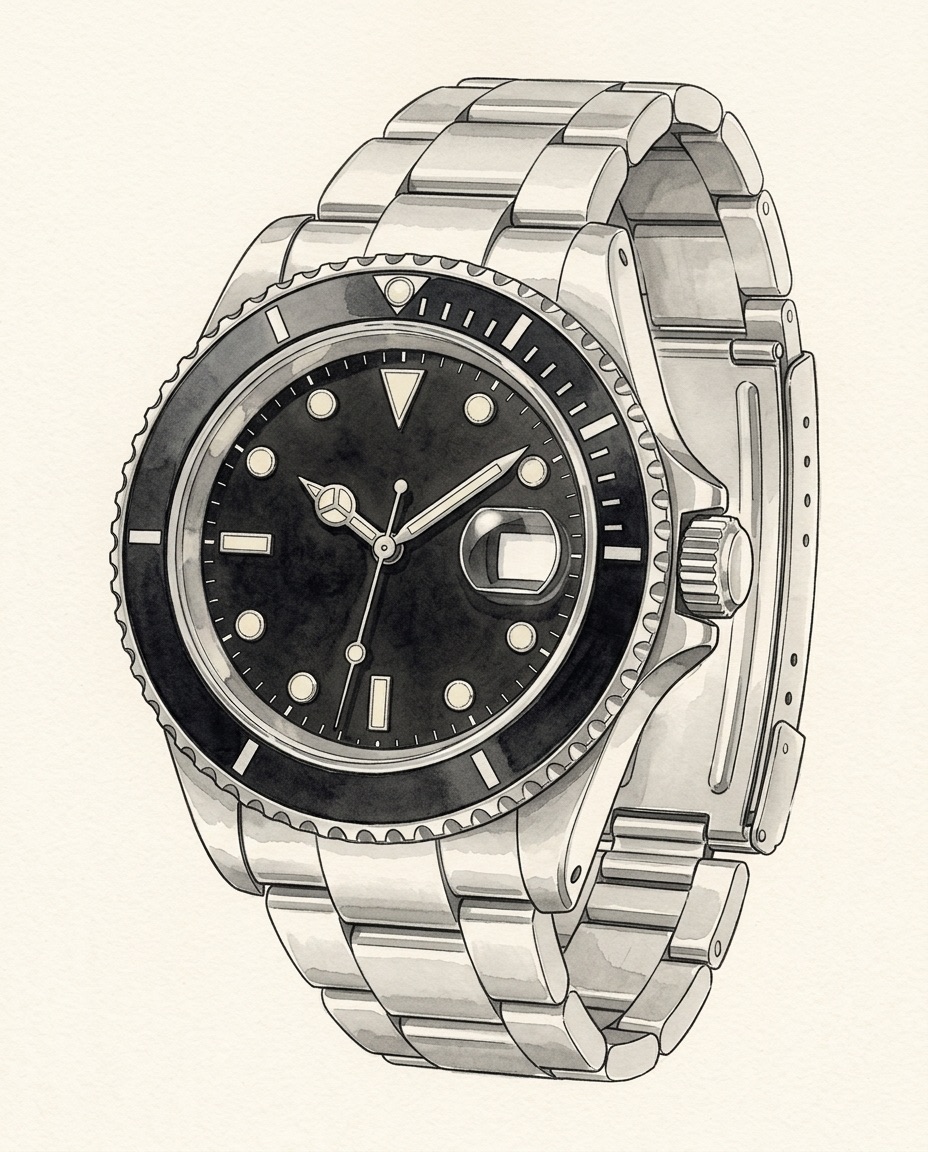
Ref. 16610 · 1988 to 2010
Guide · 12 minute read · catalogued from 49 sources
Rolex engraves a serial number on every watch and, by the dealers' own account, has never published what the numbers mean. The charts that fill the gap mostly copy one another, and the few that do not still disagree by up to three years on some letters, which is close enough to date a watch and nowhere near close enough to settle an argument.
A Rolex serial number identifies one watch; the reference number identifies the model. On older watches the serial is engraved between the lugs at six o'clock and the reference between the lugs at twelve, hidden by the bracelet1,3,4. From the mid-2000s it moved to the rehaut, the ring between dial and crystal; sources date the change from 2005 to late 20081,2,4,6,8. Serials ran as plain numbers from 1926, gained a letter prefix in 1987 and became random, carrying no date, in 2010 or 2011 depending on the source1,5,9,10. The dealers who publish dating charts say Rolex has not published one. The charts are compiled from dealers' and collectors' records and differ by up to three years on some letters1,2,3,4,5. A serial number dates a watch roughly. It does not prove that the watch is genuine2,3,7.
Look between the lugs at six o'clock on watches made before about 2005, and on the rehaut at six o'clock on later ones. From about 2005 to 2008 you may find it in both places1,2,3,11.
Letter serials ran from R in 1987 to G in 2010, in an order that is not alphabetical. Each letter covers one to four years, depending on whose table you read1,4,5,6.
Since 2010 or 2011 serials are random and carry no date; the guarantee card does that job3,5,12. Neither the serial nor the card proves a watch genuine2,3.
Ref. 16610 · 1988 to 2010
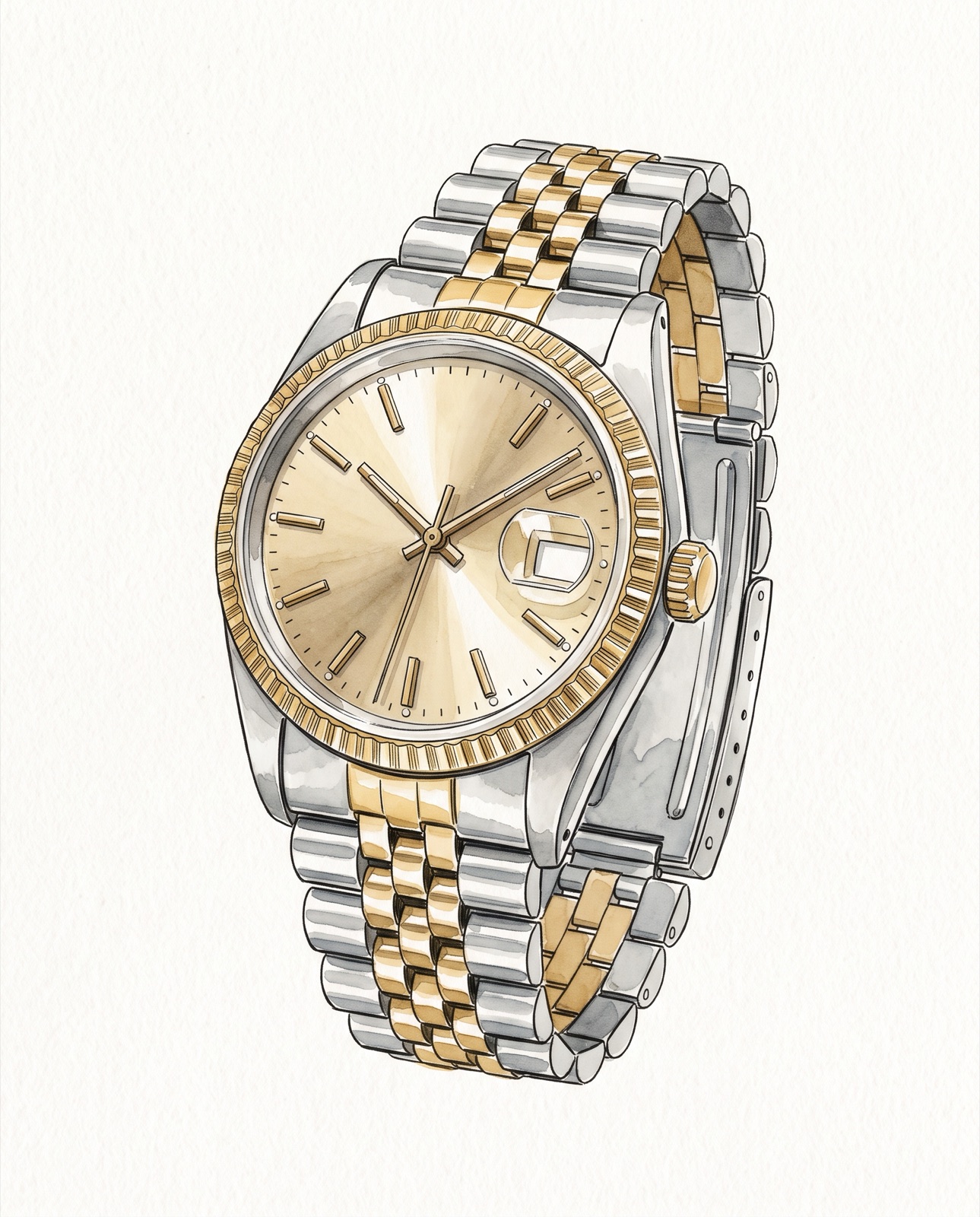
Ref. 16233 · 1988 to c. 2005
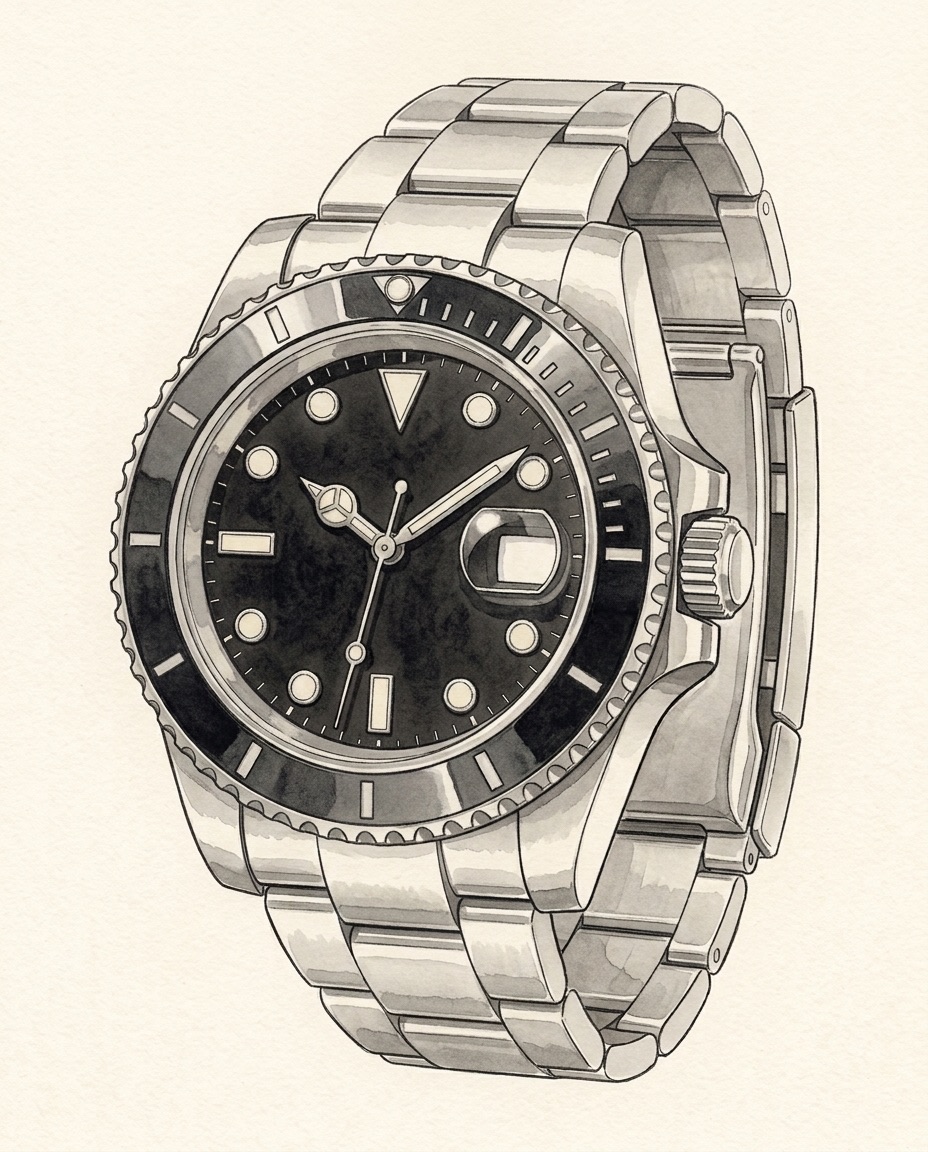
Ref. 116610LN · 2010 to 2020
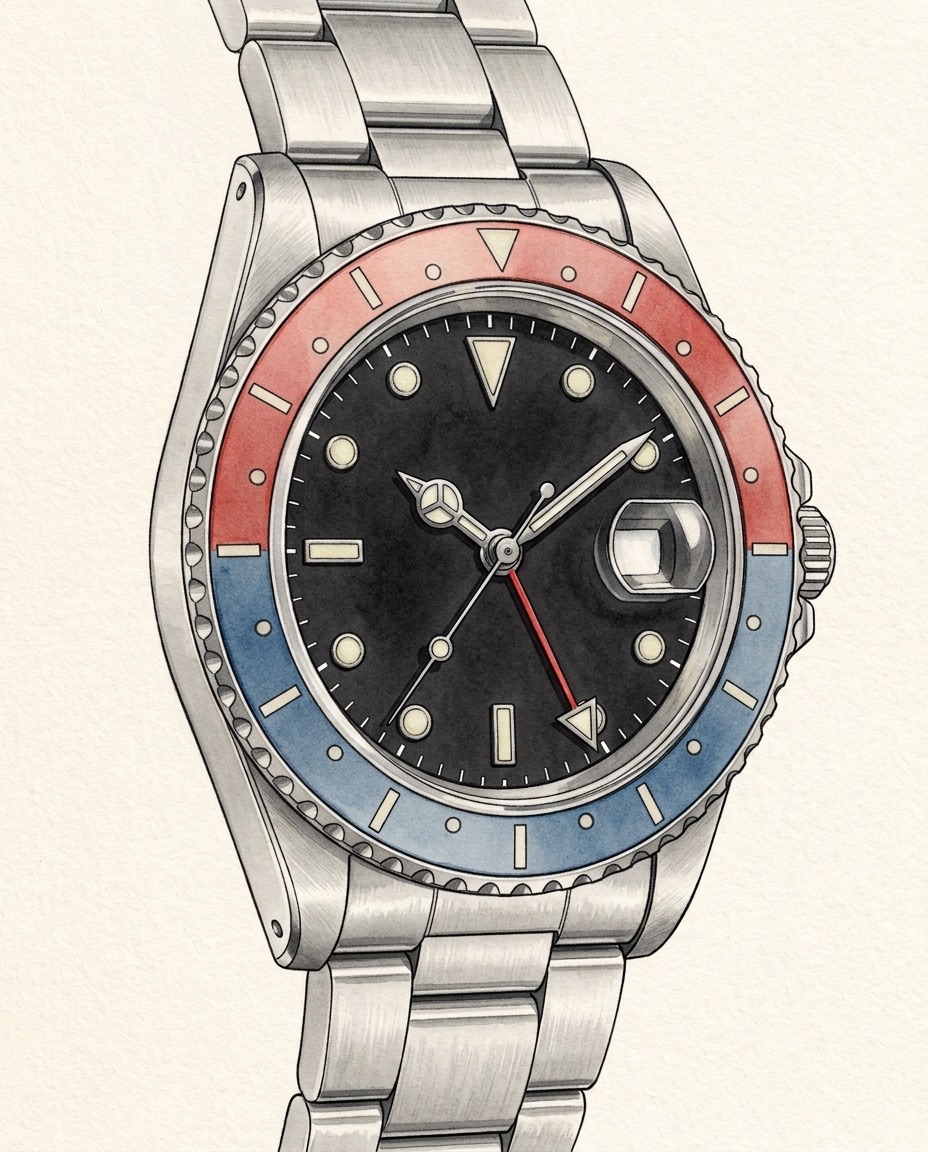
Ref. 16710 · 1989 to 2007
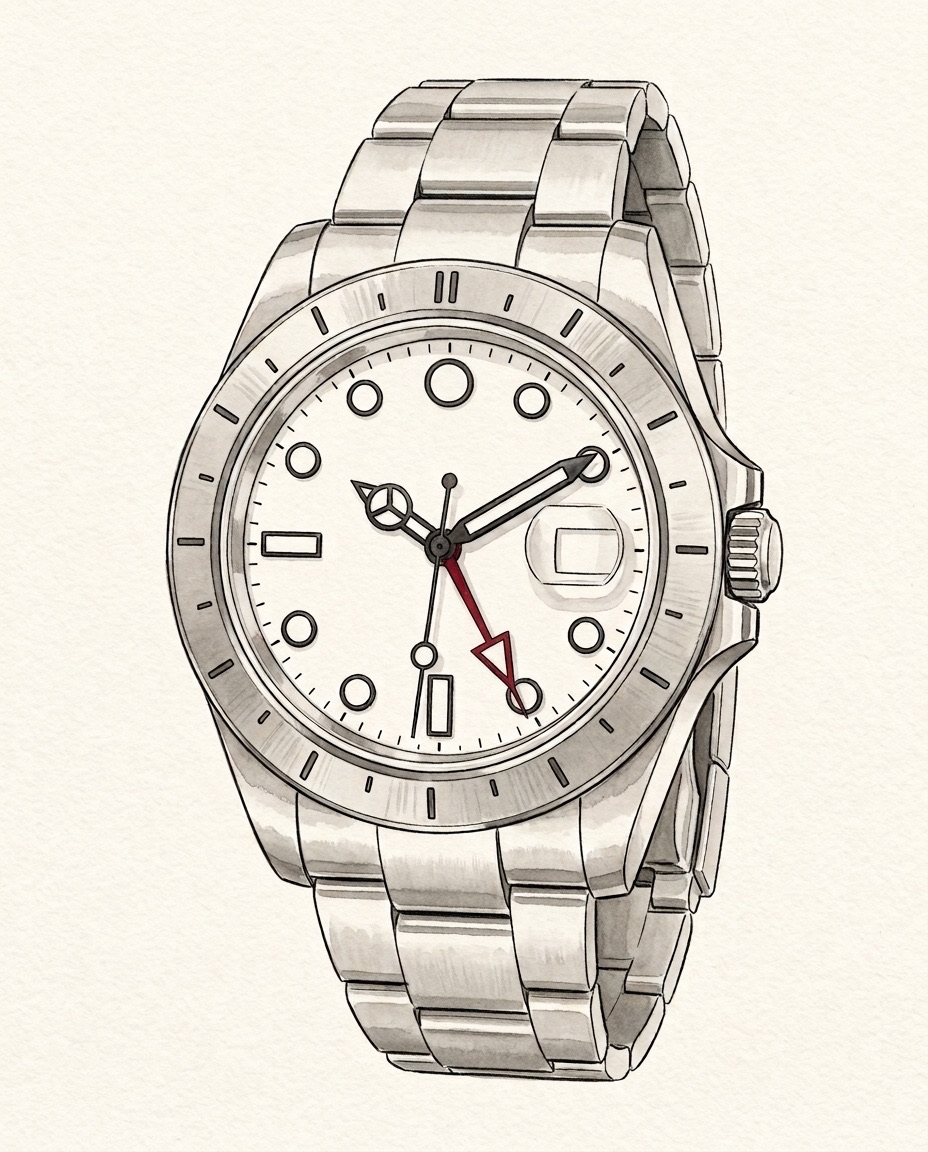
Ref. 16570 · 1989 to 2011
On a Rolex made before the mid-2000s, the serial number is engraved on the case between the lugs at six o'clock, and the reference number between the lugs at twelve. Both are hidden by the bracelet, so it has to come off before you can read them1,3,4,13. ECI suggests leaving that to a jeweller if you are not confident, because spring bars removed without the right tool can scratch the lugs3.
In the mid-2000s Rolex began engraving the serial on the rehaut, the metal ring between the dial and the crystal, at six o'clock, among the word ROLEX repeated around the ring1,2,7. From about 2008 the case between the lugs was left blank and the rehaut alone carries it1,2,3,4. Tilt the watch with twelve o'clock towards you and the number shows through the crystal2.
The year it started depends on whom you ask: 2005 for Bob's Watches, 2005 or, for some models, 2006 to 2007 for SwissWatchExpo, whose guide gives both, and late 2008 on the Submariner for Wikipedia1,4,8. On the Daytona 116520 the sources say 2006 or 200714,15. The change reached different models at different times2,4, so a range is the honest answer.
The serial is also printed on the guarantee card or certificate that came with the watch, and on a genuine set the two numbers are identical2,3,4.
The serial number belongs to one watch. The reference number, sometimes called the model number, is shared by every watch of the same model, metal and bezel2,3. The reference says what the watch is; the serial says, roughly, when it was made.
Five-digit references can be read in parts: the first two or three digits give the model family, the next the bezel and the last the metal. The dealers' standard example is 16234, read as 162 for Datejust, 3 for a fluted bezel and 4 for steel with white gold1,3,5. Our two-tone 16233 reads the same way, 162 for Datejust, 3 for fluted and 3 for steel and yellow gold, which is exactly what it is1,3,16,17.
The bezel digit works less well on sports watches. Applied by Bob's Watches itself, its key turns the 16610 into «a Submariner with an engine turned bezel»1; a 16610 has a unidirectional rotating bezel with an aluminium insert18,19. On the five references this guide links to, the last digit matches the metal every time. Treat the bezel digit as a clue.
In six-digit references, letters after the number describe the bezel or dial3,20: in 116610LN the 0 is steel and LN stands for lunette noire, a black bezel3,21,22.
Rolex began numbering its watches in 1926 and counted upwards1,3,9. When the count passed 999,999 in 1954, it started again2,3,9. Because of that restart, the same number can turn up on watches decades apart, so ECI's advice is to check the date against the reference and the style of the watch2,3.
In 1987, as the numbers approached 10 million, Rolex put a letter in front of six digits3,9; SwissWatchExpo and Gray & Sons say from mid-19874,5. The letters then ran R, L, E, X, N, C, S, W, T, U, A, P, K, Y, F, D, Z, M, V and G1,4,5. The order is not alphabetical, so use a table rather than guessing3,23.
The letters stopped in 2010 or 2011, depending on the source1,2,5,9,10. Since then serials have been random strings of letters and digits that carry no date at all1,3,5. Wikipedia adds that the last green-bezel 16610LV Submariners, made in 2010, already left with random serials8.
The dealers who publish a table of serial numbers and production years say themselves that Rolex has not published one. Bob's Watches calls its chart a list «gathered by proven authorities over the years», and Tiger River says Rolex «has never released an official production period chart»1,2,3.
Most of the charts we read are one chart. The table on Bob's Watches reappears number for number at Fratello, Luxury Watches USA and on SwissWatchExpo's lookup page, from 1954 onwards at Watch Limit, and for the letter years at Tiger River, whose figures before 1987 are its own1,2,20,24,25,26. Watch Business in Australia says outright that it compiled its version from Bob's23; the others do not say where their figures come from, and Bob's credits «proven authorities»1. Seven websites agreeing is, in this case, one chart counted seven times.
The other tables differ. SwissWatchExpo's own 2023 guide gives most letters a range, often two or three years long; Gray & Sons and Investment Watches give shorter spans and start some letters a year earlier or later4,5,6. Gray & Sons is only partly separate: its ranges before 1987 start at the common table's figures1,5. SwissWatchExpo now shows both versions: the ranges in its guide and the common table on its lookup page4,20.
Part of the disagreement is built in. Gray & Sons notes that Rolex did not change prefixes on a calendar date, and ECI that cases were made in batches and sold over time, so a serial near a change can belong to either year3,5. The serial dates the watch's production, not its sale, which can come months or years later5. The date on the guarantee card is the tiebreaker3.
Read any serial as plus or minus a year or two, and check that the rest of the watch belongs to the same period.
A random serial is eight characters of letters and digits3,20 and says nothing about the year. For these watches the guarantee card dates the sale, and Gray & Sons and ECI also point to Rolex's own service records3,5. WatchGuys notes that this is one reason full sets sell at a premium12.
Rolex says the guarantee is valid only if one of its jewellers filled in the card in full at the time of purchase, and that a guarantee card cannot be re-issued under any circumstances27. A lost card stays lost.
Bob's Watches says every Datejust 41 carries a random serial, so a dated format on one is a red flag28. The reverse holds too: Tiger River points out that a watch from the late 1990s whose serial starts with a number instead of a letter is most likely not genuine2.
A serial number is not a certificate. Counterfeiters engrave real serial numbers on fakes and print them on fake papers2,3, and Bob's Watches says the best fakes today can pass one or two of the usual tests7. Rolex's own answer to the question of authenticity is to buy from a jeweller in its retail network27. Away from that network the serial is one check among several, and no list of checks, ours included, proves a watch genuine.
What you can look at: the engraving should be deep and crisp and catch the light, while fakes are often acid-etched, with a sandy look7,13,29. On a rehaut, ROLEX running all the way round with no break for the serial is a warning sign13,30,31. The serial on the watch should match the papers3,4,7, and the watch's details should fit the date the serial suggests3,11.
When something does not match, it is a question, not a verdict. SwissWatchExpo says papers sometimes get mixed up between watches4, and ECI says a case replaced during service carries the replacement case's serial3. A faint engraving on an old watch is normal; one that looks re-engraved should be checked by a professional3,11. Before a private purchase, ECI and Langedyk suggest checking the serial against stolen-watch registers3,11.
Bob's Watches' advice, when any doubt remains, is to verify the serial against the paperwork and have the watch inspected in person7. It narrows the risk. It does not remove it.
The Submariner Date 16610 was made from 1988 to 201019,21,32,33, almost exactly the letter era, so its serial gives a usable first date. The sources date its engraved rehaut between 2005 and about 200718,19,21.
The two-tone Datejust 16233, made from 1988 to about 2005, keeps its serial between the lugs, and its rehaut is plain7,16,34,35. An engraved rehaut on a 16233 is a reason to ask why7,36,37.
On the GMT-Master II 16710, made from 1989 to 200738,39,40,41, dealers use the serial letters as a calendar of changes. Exquisite Timepieces ties the end of the lug holes to late Y serials, and Bob's Watches puts calibre 3186 in late Z- and M-serial watches from late 200712,42,43.
The Explorer II 16570 ran from 1989 to 201144,45,46,47, through almost the whole letter era and, by the tables' dates, into the random one1,5. The Submariner Date 116610LN was made from 2010 to 20208,48,49, so nearly all of its run falls after the letters. Date one by its card, not its serial3,12.
Many Rolex clasps carry a code inside the hinge: one or two letters for the year and a number for the month, so G4 means April 1982, and an added S marks a service replacement1,3,5. It dates the bracelet, which may have been replaced, so use it alongside the serial, never instead of it3,20. Clasp codes, too, became random around 2010 or 20111,4,5.
| Period | Where to look | Format |
|---|---|---|
| Before about 2005 | Between the lugs at six o'clock, under the bracelet1,2,3 | Numbers only until 1987, then a letter and six digits3,9 |
| About 2005 to 2008 | Between the lugs, on the rehaut, or both2,3,4,11 | A letter and six digits3 |
| About 2008 to 2010 | On the rehaut at six o'clock only1,2,3 | A letter and six digits3 |
| 2010 or 2011 onwards | On the rehaut at six o'clock3,5 | Random, eight characters, no date3,20 |
Approximate dates; the sources put the move to the rehaut anywhere from 2005 to late 2008.
| Letter | Common table (Bob's Watches and six other sites) | SwissWatchExpo guide, 2023 | Gray & Sons | Investment Watches (year introduced) | Spread |
|---|---|---|---|---|---|
| R | 1987–1988 | mid-1987 to 1988 | 1987 | 1987 | 1987–19881,4,5,6 |
| L | 1989 | 1989–1990 | 1988–1989 | 1989 | 1988–19901,4,5,6 |
| E | 1990 | mid-1990 to early 1991 | 1990 | 1990 | 1990–19911,4,5,6 |
| X | 1991 | mid-1991 | 1991 | 1991 | 19911,4,5,6 |
| N | 1991 | late 1991 | 1991 | 1991–1992 | 1991–19921,4,5,6 |
| C | 1992 | early 1992 | 1992 | 1992 | 19921,4,5,6 |
| S | 1993–1994 | late 1993 | 1993–1994 | 1993 | 1993–19941,4,5,6 |
| W | 1995 | 1995–1998 | 1994–1995 | 1995 | 1994–19981,4,5,6 |
| T | 1996 | 1996–1998 | 1995–1996 | 1996 | 1995–19981,4,5,6 |
| U | 1997–1998 | 1997–1998 | 1997–1998 | 1997 | 1997–19981,4,5,6 |
| A | 1999 | 1998–2000 | 1998–1999 | 1998 | 1998–20001,4,5,6 |
| P | 2000 | 2000–2001 | 1999–2000 | 2000 | 1999–20011,4,5,6 |
| K | 2000–2001 | 2001–2003 | 2000–2001 | 2001 | 2000–20031,4,5,6 |
| Y | 2001–2002 | 2002–2004 | 2001–2002 | 2002 | 2001–20041,4,5,6 |
| F | 2003–2005 | 2004–2005 | 2003–2005 | 2003 | 2003–20051,4,5,6 |
| D | 2005–2006 | 2005–2006 | 2005–2006 | 2005 | 2005–20061,4,5,6 |
| Z | 2006–2007 | 2006–2008 | 2006–2008 | 2006 | 2006–20081,4,5,6 |
| M | 2007–2008 | 2007–2009 | 2007–2009 | 2007 | 2007–20091,4,5,6 |
| V | 2008–2009 | 2008–2009 | 2009 | 2008 | 2008–20091,4,5,6 |
| G | 2010 | 2009–2010 | 2010 | 2010 | 2009–20101,4,5,6 |
| Random | 2011 onwards | 2010 onwards | 2011 onwards | 2010 onwards | 2010 or 2011 onwards1,4,5,6 |
The dealers who publish tables like this say Rolex has not published one; the tables are compiled from dealers' and collectors' records1,2,3. The common table, on Bob's Watches and reproduced by Fratello, Watch Limit, Tiger River, Luxury Watches USA, SwissWatchExpo's lookup page and Watch Business, gives one serial per year (R598,200 for 1988, for example); we list every year in which a letter appears1,2,20,23,24,25,26. SwissWatchExpo's fractional years (1993¾) are shown as early, mid or late. Spread is our own summary: the earliest to the latest year in the four columns.
| Year | Common table (Bob's Watches, Fratello and others) | SwissWatchExpo guide, 2023 | Tiger River |
|---|---|---|---|
| 1926 | 00,0011,24 | 28,0004 | 0–20,0002 |
| 1953 | 855,7261,24 | 869,0004 | 880,000–999,0002 |
| 1954 | 23,0001,24 | 935,0004 | 0–50,0002 |
| 1960 | 516,0001,24 | 1,401,0004 | 550,000–650,0002 |
| 1970 | 2,241,8821,24 | 2,952,0004 | 2,240,000–2,590,0002 |
| 1980 | 6,434,0001,24 | 6,430,0004 | 6,205,000–6,560,0002 |
| 1987 | 9,400,0001,24 | 9,760,0004 | 9,860,000–9,900,0002 |
Bob's Watches and SwissWatchExpo do not say whether a number marks the start of the year; Tiger River gives ranges. SwissWatchExpo's numbers keep climbing through 1954 although its own text describes the reset. The common table gives 5,008,000 for 1977 and 5,000,000 for 1978, which run backwards, and Bob's Watches' text cites 28000 for 1926 while its table starts at 00,0011,2,4. Use these figures as a rough guide to decade, not year.
Should you trust a serial number? Trust it to tell you roughly when, never whether. Read the letter, allow a year or two either way, check that the dial, case and papers agree with it, and have a watchmaker you trust open the case.
The house rules · every fact sourced, every disagreement shownWhen the serial moved to the rehaut. 2005 (Bob's Watches, Tiger River, Langedyk and SwissWatchExpo's summary), some models from 2006 to 2007 (SwissWatchExpo's text), after 2007 (Investment Watches) or late 2008 for the Submariner (Wikipedia). Luxury Bazaar puts the first engraved rehauts on some Turn-O-Graph models in 2004, without saying whether they carried the serial. We write «from the mid-2000s», with the rehaut alone from about 20081,2,4,6,8,11,30.
When serials went random. 2010 (Wikipedia, ECI, SwissWatchExpo's guide), towards the end of 2010 (Tiger River), 2011 (Bob's Watches, aBlogtoWatch) or mid-2011 (Gray & Sons). We write «2010 or 2011»1,2,3,4,5,9,10.
Where the count restarted in 1954. From zero, say Wikipedia and Tiger River; from 100,000, says SwissWatchExpo. The common table gives 23,000 for 1954, and Gray & Sons' version of it files everything from 0 to 22,999 under 1926 to 19531,2,4,5,9.
How long each letter lasted. The four tables agree on the order, not the years: W runs from 1994 to 1998 across them, K from 2000 to 20031,4,5,6. We show all four.
How long a random serial is. Eight characters, say ECI and SwissWatchExpo's lookup page. Watch Business calls them six-character serials, then gives AB123456, which has eight3,20,23.
Clasp codes in the late 1990s. Bob's Watches: V 1996, Z 1997. Gray & Sons: U 1996, V 19971,5.