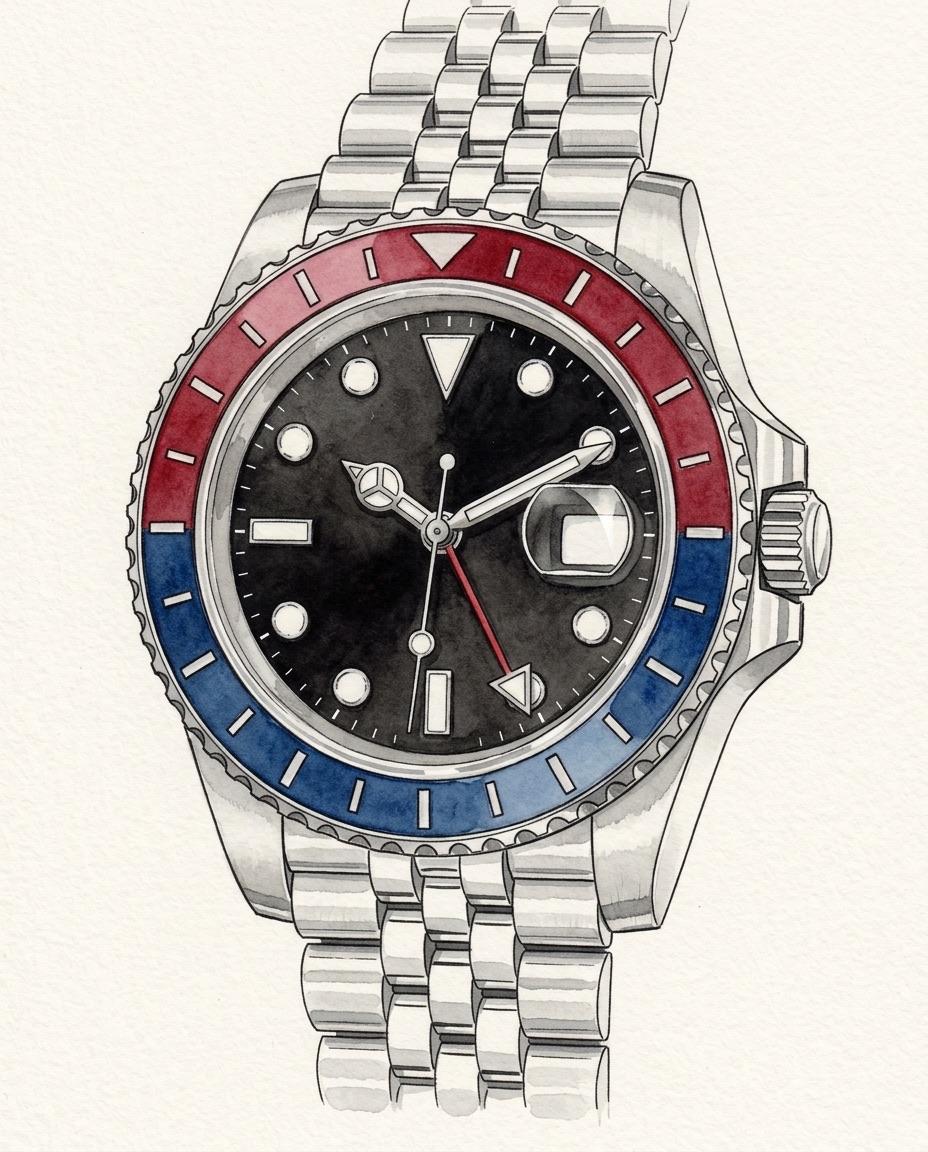
Ref. 126710BLRO · 2018 to 2026
Rolex · The GMT-Master II, model by model · catalogued from 58 sources
Rolex built the GMT-Master so that pilots could read two time zones at a glance. For most buyers since, the harder question has been which colours to read them in.
The Rolex GMT-Master II is the GMT-Master with an hour hand that can be set on its own. The GMT-Master, made with Pan American World Airways, dates from 1955 by Rolex's account, with production from 1954 by Sotheby's4,11,20; the GMT-Master II followed in 1982 or 19834,5,6,21. On 16 October 2026 rolex.com's US and UK sites listed 13 GMT-Master II models under eight references, all 40 mm and none with a BLRO (red-and-blue) model number1,2. The steel 126710BLRO left the catalogue in April 2026, around Watches and Wonders; the exact day is disputed7,9,10,11,12,13,14.
Two lines under one name: the GMT-Master, made until 1999, whose hour and 24-hour hands move together, and the GMT-Master II, whose hour hand can be set on its own3,4,7,8.
Three bezel eras in steel: aluminium until 2007, all-black ceramic from 2007 to 2019, two-colour ceramic since 20134,5,22,23,24.
On Chrono24 in February 2026, our median asking price for the steel 126710BLRO was, by our calculation, about 1.7 times the 116710LN's25,26. Asking prices are not sale prices.
Ref. 126710BLRO · 2018 to 2026
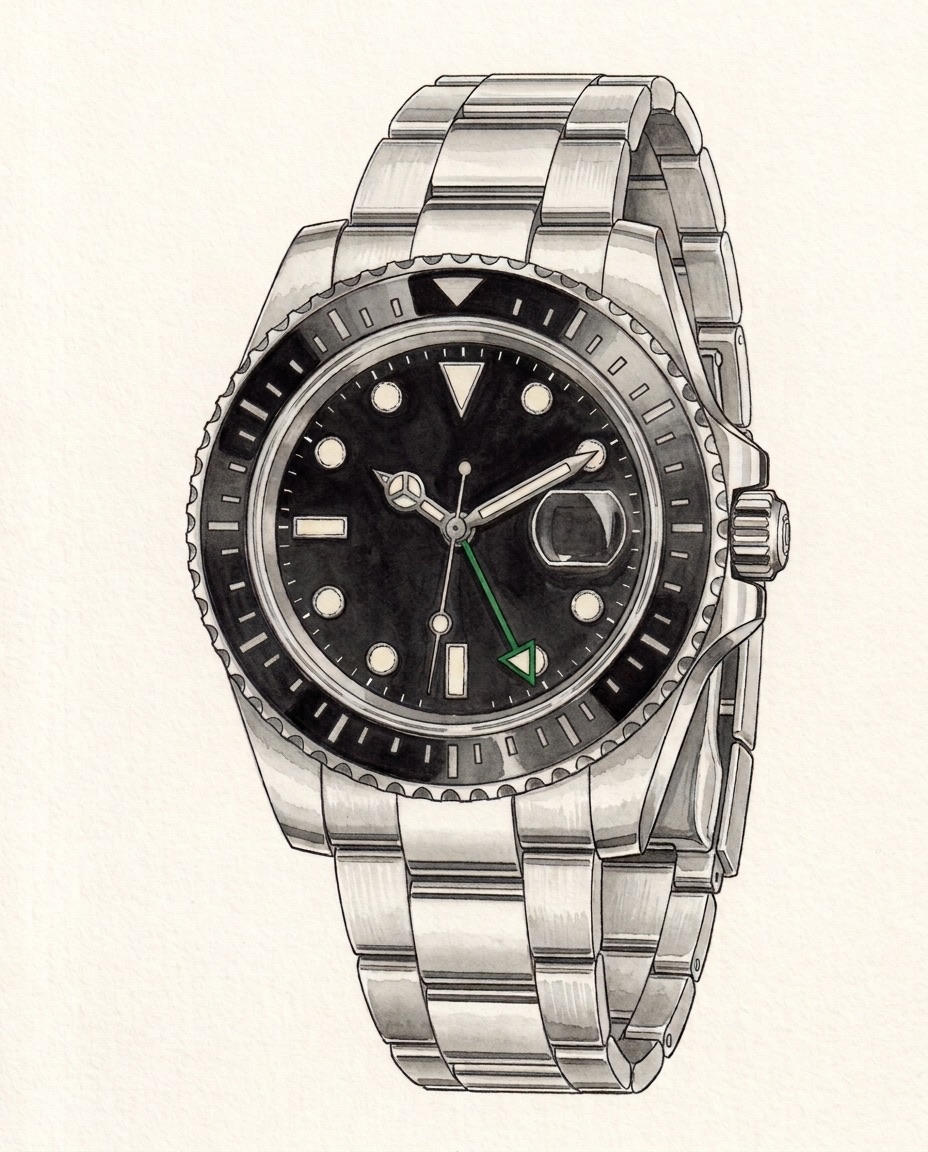
Ref. 116710LN · 2007 to 2019
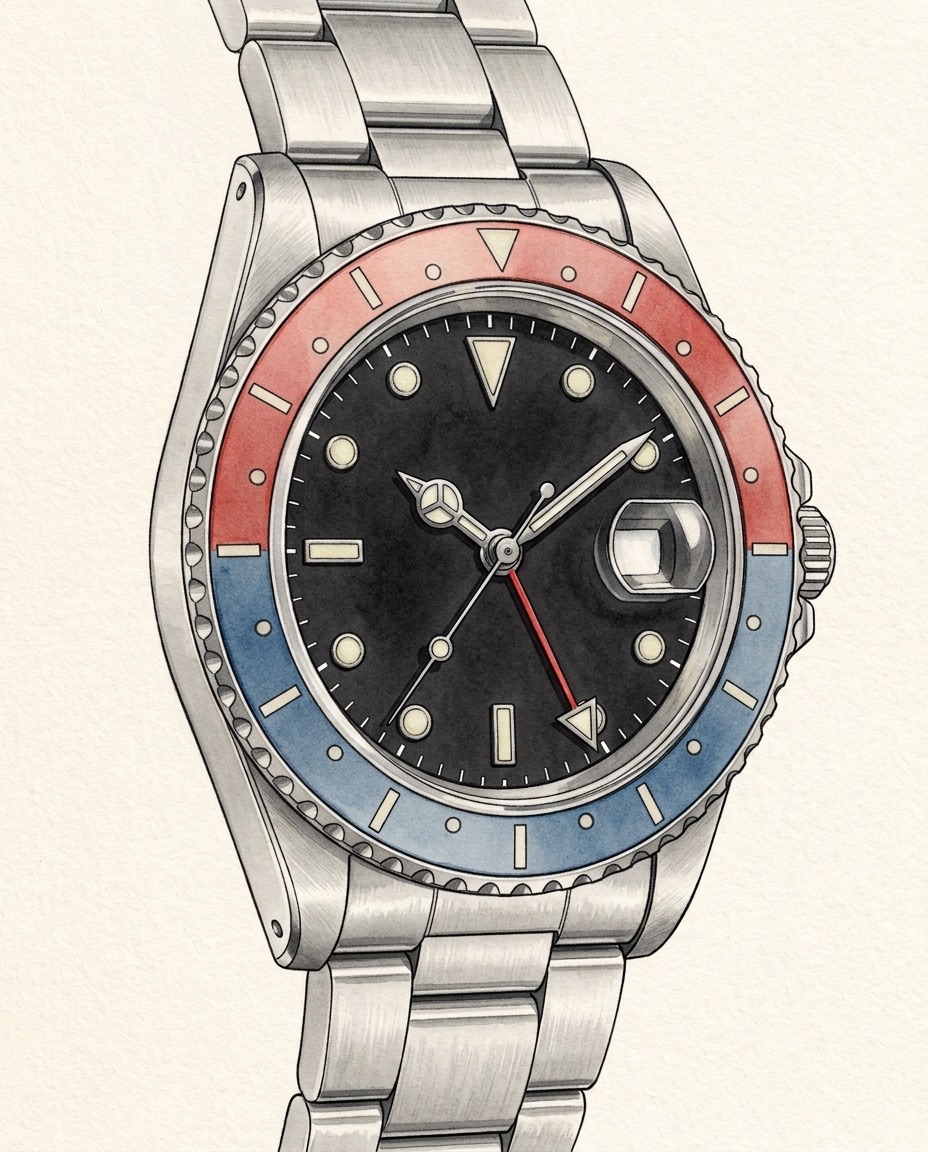
Ref. 16710 · 1989 to 2007
The GMT-Master was developed with Pan American World Airways for long-haul crews4,7,11. A fourth hand goes round the dial once in 24 hours, and the bezel was red for the daytime hours and blue for the night7,12. Rolex dates the first reference, the 6542, to 1955, and Sotheby's starts its production in 195411,12,20.
Ref. 1675 followed in 1959 with crown guards, a 40 mm case and an aluminium insert, and ran until 19803,5,7. Ref. 16750, from 1980 or 1981, brought calibre 3075, a quick-set date and 100 metres3,5,7,8. The last GMT-Master, ref. 16700, ran from 1988 or 1989 to 1999, alongside the GMT-Master II3,5,7,8.
The GMT-Master II arrived as ref. 16760, in 1982 by Rolex's account and 1983 by several dealers'. Its calibre 3085 let the hour hand be set on its own in one-hour steps, so the 24-hour hand could keep home time and the bezel a third zone3,4,5,6,21. Its thicker case earned it the nickname 'Fat Lady'8,21,22.
Ref. 16710 replaced the 16760 in 1989 and ran until 2007, the longest GMT-Master II so far. It was slimmer, with calibre 3185 and, in the last examples, 3186, and its aluminium insert came in red and blue, red and black, or black5,18,21,22,27. The two-tone and yellow-gold versions were the 16713 and 167183,21. It was the last steel 'Pepsi' with an aluminium insert7,11.
Ceramic came first in gold. Rolex says the GMT-Master II was its first watch with a Cerachrom insert, in 2005: the yellow-gold 116718LN, in black4,21,28. The steel 116710LN followed in 2007, with broader lugs on the same 40 mm, a green 24-hour hand and an Oyster bracelet only15,16,29. Two colours arrived in 2013 on the blue-and-black 116710BLNR, and red and blue in 2014, on the white-gold 116719BLRO only3,4,5,7,30.
In 2018 the red-and-blue Cerachrom bezel reached steel as ref. 126710BLRO, on a Jubilee bracelet, with calibre 3285 and about 70 hours of power reserve7,11,31. The same year brought the Everose-gold 126715CHNR and the steel-and-Everose 126711CHNR, both with brown-and-black bezels, and the white-gold 126719BLRO3,5,7,8.
At Baselworld 2019 the blue-and-black 126710BLNR replaced the 116710BLNR, and the 116710LN was discontinued with the gold and two-tone black-bezel models; Monochrome reported that every GMT-Master II would now have a two-colour bezel24,28,32. An Oyster bracelet became an option on both steel 126710s in 202130,33.
In 2022 the 126720VTNR moved the crown and date to the left, with a green-and-black bezel4,5,34. Grey and black came on the two-tone 126713GRNR and yellow-gold 126718GRNR in 2023, and on the steel 126710GRNR in 20243,5,8,35. In 2025 came Rolex's first ceramic dial, in green, on the white-gold, left-handed 126729VTNR1,3,4.
Then the red went. In April 2026, around Watches and Wonders, the 126710BLRO and the white-gold 126719BLRO left the catalogue; the exact day is disputed, and we found no reason from Rolex7,9,10,11,12. On 16 October 2026 its US page returned «page not found»13,14.
We read the GMT-Master II catalogue on rolex.com's US and UK sites on 16 October 2026. Both listed the same 13 models under eight references, all 40 mm Oyster cases1,2: in Oystersteel, the 126710BLNR, 126710GRNR and left-handed 126720VTNR; in Oystersteel and gold, the 126711CHNR and 126713GRNR; in gold, the 126715CHNR, 126718GRNR and 126729VTNR1,2.
None of the 13 carried a BLRO number1,2,36. In Bob's Watches' words, that leaves no red bezel in current production7.
The GMT-Master has grown once. The 6542 measured 38 mm; from the 1675 of 1959 the case has been 40 mm3,5,7. Every GMT-Master II reference in WatchGuys' table is 40 mm, and so is every model in Rolex's catalogue today1,3.
What changed is the shape around those 40 mm. The 16710 is about 12 mm thick and 47 mm lug to lug, with 20 mm between the lugs22,37,38. The 116710LN got broader lugs and crown guards, the Super Case, at the same 20 mm lug width by Bob's Watches' account15,23,29, and the 126710 of 2018 went back to thinner, more tapered lugs31.
GMT-Master or GMT-Master II. On a GMT-Master the hour hand and the 24-hour hand are coupled; on a GMT-Master II the hour hand jumps on its own3,4,5. In September 1996, when both were sold, a dealer's US retail table, not a Rolex document, shows the steel GMT-Master at USD 3,300 and the GMT-Master II at USD 3,50039.
16710, 116710LN or 126710. The 16710's aluminium insert scratches, fades and can be swapped in minutes; Cerachrom is virtually scratchproof by Rolex's account but can chip20,22,29,40. The 3185 and 3186 hold about 48 to 50 hours, the 3285 about 7016,18,31. The 16710 and 126710 come on an Oyster or a Jubilee, the 116710LN on an Oyster only22,33,40.
126710BLRO or 126710BLNR. Only the bezel and the 24-hour hand differ: red and blue with a red hand, or blue and black with a blue hand. Case, calibre and bracelets are the same12,31,41. The BLNR is still in the catalogue; the BLRO is not1,13.
GMT-Master II or Explorer II. The near relative with a 24-hour hand is the Explorer II, presented in 1971 for polar explorers and speleologists42,43. Its ref. 16570 (1989 to 2011) used the GMT-Master II's calibres of the time, 3185 and then 3186, in a 40 mm case17,18,44. The difference is the bezel: fixed steel, engraved with 24 hours, so Monochrome calls it a two-zone watch against the GMT-Master's three17,19. Its successor grew to 42 mm in 201144,45.
The prices in the table below come from our reference pages, with their dates and labels; nothing here is a new valuation, and only our ratios between them are new. The steel 126710GRNR on a Jubilee was USD 12,000 on rolex.com's US site on 16 October 202646.
Second-hand, the gaps are wider. In February 2026 our median asking price on the first page of Chrono24's 126710BLRO listings, USD 23,200, was by our calculation about 1.7 times the 116710LN's, USD 13,360 without other references and modified watches25,26. The 126710BLRO's page mixes new, unworn and pre-owned watches.
The aluminium 16710 and its ceramic successor sit close together, and which is ahead depends on the measure. In October 2025, by our calculation on our Chrono24 medians, the 116710LN asked 2.6 per cent more than the 16710 with each page's own filter, 3.1 per cent counting every listing47,48. In Bob's Watches' own sales over the year to August 2026, the 16710 averaged about USD 15,200 and the 116710LN about USD 13,90049,50. The two point different ways, over different periods, and neither is the market.
If you want the GMT-Master II as Rolex makes it now, the steel 126710BLNR, 126710GRNR and left-handed 126720VTNR are in the catalogue at list price, from the jewellers Rolex appoints1,46,51.
If you want red and blue in ceramic and steel, there is one reference, the 126710BLRO, now second-hand only7,9. In aluminium it is the 16710, the last steel 'Pepsi' with that insert; ask whether the insert is the one it left the factory with7,22,49.
If you want ceramic without colour, the 116710LN is the only steel GMT-Master II with an all-black ceramic bezel15,16. If you want a 24-hour hand without a rotating bezel, look at the Explorer II 1657017,44. None of the checks on our reference pages proves a watch genuine; they only help you walk away from a bad one.
Aluminium inserts on the 1675 and 16750 fade towards pale blue and pink, and Bob's Watches says the few that turn a saturated fuchsia carry a premium over unfaded ones7. Few industries pay the sun as a co-author.
| Reference | Line | Years | Case and bezel | Calibre |
|---|---|---|---|---|
| 6542 | GMT-Master | 1954 or 1955 to 19595,7,11,20 | Steel, 38 mm; Bakelite, later aluminium insert in red and blue3,7,11 | 1065 and 1066; WatchGuys and Fratello also list 10363,5,52 |
| 1675 | GMT-Master | 1959–19803,5,7 | Steel, 40 mm, crown guards; aluminium insert; also in gold and in steel and gold3,5,7 | 1565, later 15753,11,52 |
| 16750 | GMT-Master | 1980 or 1981 to 19883,5,7,8 | Steel, 40 mm; aluminium insert; quick-set date, 100 metres5,7,8 | 30753,5,8 |
| 16700 | GMT-Master | 1988 or 1989 to 19993,5,7,8 | Steel, 40 mm, sapphire crystal; the last GMT-Master7,8 | 31753,8 |
| 16760 | GMT-Master II | 1982 or 1983 to 19883,4,5,6,21 | Steel, thicker 'Fat Lady' case; red-and-black aluminium insert, by most sources8,21,22 | 30853,5,21 |
| 16710 | GMT-Master II | 1989–20073,5,21,22 | Steel, 40 mm; aluminium insert in red and blue, red and black, or black; Oyster or Jubilee21,22,38 | 3185, last examples 31865,18,22 |
| 16713 / 16718 | GMT-Master II | Alongside the 167103,21 | Steel and yellow gold / yellow gold; aluminium insert3,21 | 31853,18 |
| 116718LN | GMT-Master II | 2005–20194,21,24,28 | Yellow gold; the first Cerachrom insert, in black4,21,28 | 31863 |
| 116713LN | GMT-Master II | About 2006–201924,32 | Steel and yellow gold; black Cerachrom5,32 | 31865 |
| 116710LN | GMT-Master II | 2007–201916,23,24,32 | Steel, 40 mm; black Cerachrom; Oyster bracelet only15,29,40 | 318620,29 |
| 116710BLNR | GMT-Master II | 2013–201923,52,53 | Steel; blue-and-black Cerachrom, the first two-colour insert3,4,5 | 318623,53 |
| 116719BLRO | GMT-Master II | 2014–20185,7 | White gold; the first red-and-blue Cerachrom7,11,30 | 31863 |
| 126710BLRO | GMT-Master II | 2018–20267,9,31 | Steel, 40 mm; red-and-blue Cerachrom; Jubilee, Oyster from 202130,31,33 | 32857,31 |
| 126711CHNR | GMT-Master II | 2018–present1,3,5,8 | Oystersteel and Everose gold; brown-and-black Cerachrom1,5,8 | 32853 |
| 126715CHNR | GMT-Master II | 2018–present1,3,5,8 | Everose gold; brown-and-black Cerachrom1,5,8 | 32853,8 |
| 126719BLRO | GMT-Master II | 2018–20265,7,9 | White gold; red-and-blue Cerachrom5,7 | 32853 |
| 126710BLNR | GMT-Master II | 2019–present1,3,24 | Steel, 40 mm; blue-and-black Cerachrom; Jubilee, Oyster from 202124,33 | 32855,54 |
| 126720VTNR | GMT-Master II | 2022–present1,4,5,34 | Steel, 40 mm; green-and-black Cerachrom; crown and date on the left4,5 | 32853,5 |
| 126713GRNR | GMT-Master II | 2023–present1,3,5,8 | Oystersteel and yellow gold; grey-and-black Cerachrom1,5,8 | 32853 |
| 126718GRNR | GMT-Master II | 2023–present1,3,5 | Yellow gold; grey-and-black Cerachrom1,3,5 | 32853 |
| 126710GRNR | GMT-Master II | 2024–present1,3,8,35 | Steel, 40 mm; grey-and-black Cerachrom, green 24-hour hand35,46 | 328546,53 |
| 126729VTNR | GMT-Master II | 2025–present1,3,4 | White gold; green-and-black Cerachrom, green ceramic dial, crown on the left1,3,4 | 32853 |
Years are disputed in several places; see «Where the sources disagree». «Present» means listed on rolex.com's US and UK sites on 16 October 2026. Left out: gem-set and other off-catalogue versions, and the gold variants of the 6542 and 16750. The calibres for most of the gold and two-tone references rest on WatchGuys' reference table alone.
| Reference | Case | Bezel | Versions listed |
|---|---|---|---|
| 126710BLNR | Oystersteel, 40 mm1 | Blue and black3,24 | 21,2 |
| 126710GRNR | Oystersteel, 40 mm1 | Grey and black3,35 | 21,2 |
| 126720VTNR | Oystersteel, 40 mm, crown on the left1,4 | Green and black3,5 | 21,2 |
| 126711CHNR | Oystersteel and Everose gold, 40 mm1 | Brown and black3,8 | 11,2 |
| 126713GRNR | Oystersteel and yellow gold, 40 mm1 | Grey and black3,8 | 11,2 |
| 126715CHNR | Everose gold, 40 mm1 | Brown and black3,8 | 2: black or tiger iron dial1,2 |
| 126718GRNR | Yellow gold, 40 mm1 | Grey and black3,5 | 2: black or tiger iron dial1,2 |
| 126729VTNR | White gold, 40 mm, crown on the left1,4 | Green and black, green ceramic dial1,3 | 11,2 |
Read from the catalogue data on rolex.com's US and UK «all models» pages on 16 October 2026; both listed the same 13 model numbers, and neither listed a BLRO. The case column is Rolex's wording; the bezel colours come from the sources named, because the catalogue data we saved does not name them. Rolex's prices are not shown here: only the one our reference pages already use appears in the price table.
| Reference | Last list or retail figure we found | Median asking price, Chrono24 first page | One dealer's sales (Bob's Watches) |
|---|---|---|---|
| 16710 | USD 5,750, March 2008, from a dealer's US retail table, not Rolex39 | USD 12,768, October 2025, all listings48 | Average about USD 15,200, twelve months to August 202649 |
| 116710LN | USD 8,450, June 2012, from the same dealer table; WatchGuys gives the same last US retail39,40 | USD 13,360, February 2026, without other references and modified watches; USD 13,377 counting every listing26 | Average about USD 13,900, twelve months to August 202650 |
| 126710BLRO | USD 11,300, Jubilee, 10 October 2025, rolex.com US (archived copy)55 | USD 23,200, February 2026; the page mixes new, unworn and pre-owned watches25 | Median USD 25,433, May to July 20267 |
| 126710GRNR | USD 12,000, Jubilee, 16 October 2026, rolex.com US46 | Not measured | Not measured |
| 16570 (Explorer II) | USD 6,325, September 2010, from the same dealer table39 | USD 8,123, October 2025, without retailer-signed and provenance listings56 | Median about USD 9,600, July 2025 to July 202657 |
All figures in US dollars and copied from our reference pages for each watch, where the method is explained. Chrono24 figures are our medians of archived copies of the first page, from October 2025 or February 2026 as shown; asking prices are not sale prices. Bob's Watches' figures are its own sales: an average for some references and a median for others, over different periods, so compare them along a row, not down a column. The dealer table began as a Rolex dealer's handout and is not a Rolex document.
Should you buy one? Choose the bezel you would wear on an ordinary Tuesday, not the one that photographs best. The reference number will follow.
The house rules · every fact sourced, every disagreement shownWhen the GMT-Master arrived. Rolex dates the GMT-Master to 1955, and Bob's Watches and WatchGuys date the 6542 from 1955. Sotheby's says it debuted in 1955 but was produced from 1954, Fratello says 1954, and Wikipedia gives 1954 in its text and 1955 in its fact box. We give both3,4,7,11,12,20,52.
When the GMT-Master II arrived. Rolex, Monochrome and WatchGuys say 1982; Beckertime, Gray & Sons and Bob's Watches say 1983. We write 1982 or 19833,4,5,6,21,29.
The 16750 and the 16700. Monochrome and Bob's Watches start the 16750 in 1980, WatchGuys in 1981, and SwissWatchExpo gives both. Bob's Watches, Monochrome and SwissWatchExpo start the 16700 in 1988, WatchGuys in 1989. We write 1980 or 1981, and 1988 or 19893,5,7,8.
The modern launch years. WatchGuys' timeline puts the 126713GRNR, 126718GRNR and 126729VTNR in 2024, but its own table says 2023 for the first two and 2025 for the third, as do Monochrome and SwissWatchExpo for the grey-and-black models and Rolex for its first ceramic dial. SwissWatchExpo starts the 126720VTNR in 2023, against Rolex's 2022; WatchGuys starts the 126719BLRO in 2019, against Bob's Watches' 20183,4,5,7,8.
When the 126710BLRO was discontinued. Bob's Watches and Complex say 14 April 2026, the opening day of Watches and Wonders; Sotheby's says 1 April; Wikipedia says the watch was gone from Rolex's and dealers' websites before the fair. We say April 20267,9,11,12.
The 116713LN's first year. Beckertime puts the two-tone 116713LN a year after the gold 116718LN of 2005; Monochrome gives no year. We write about 20065,32.
The 116710LN's years. Fratello starts the 116710LN in 2008, and one Bob's review ends it around 2018. Our other sources give 2007 and 2019, which we use15,16,23,24,29,32,52.
The first red-and-blue ceramic bezel. Bob's Watches' 2026 article gives the first red-and-blue Cerachrom insert to the 126710BLRO; its 'Pepsi' guide, aBlogtoWatch and Sotheby's give it to the white-gold 116719BLRO of 2014, as we do7,11,30,58.