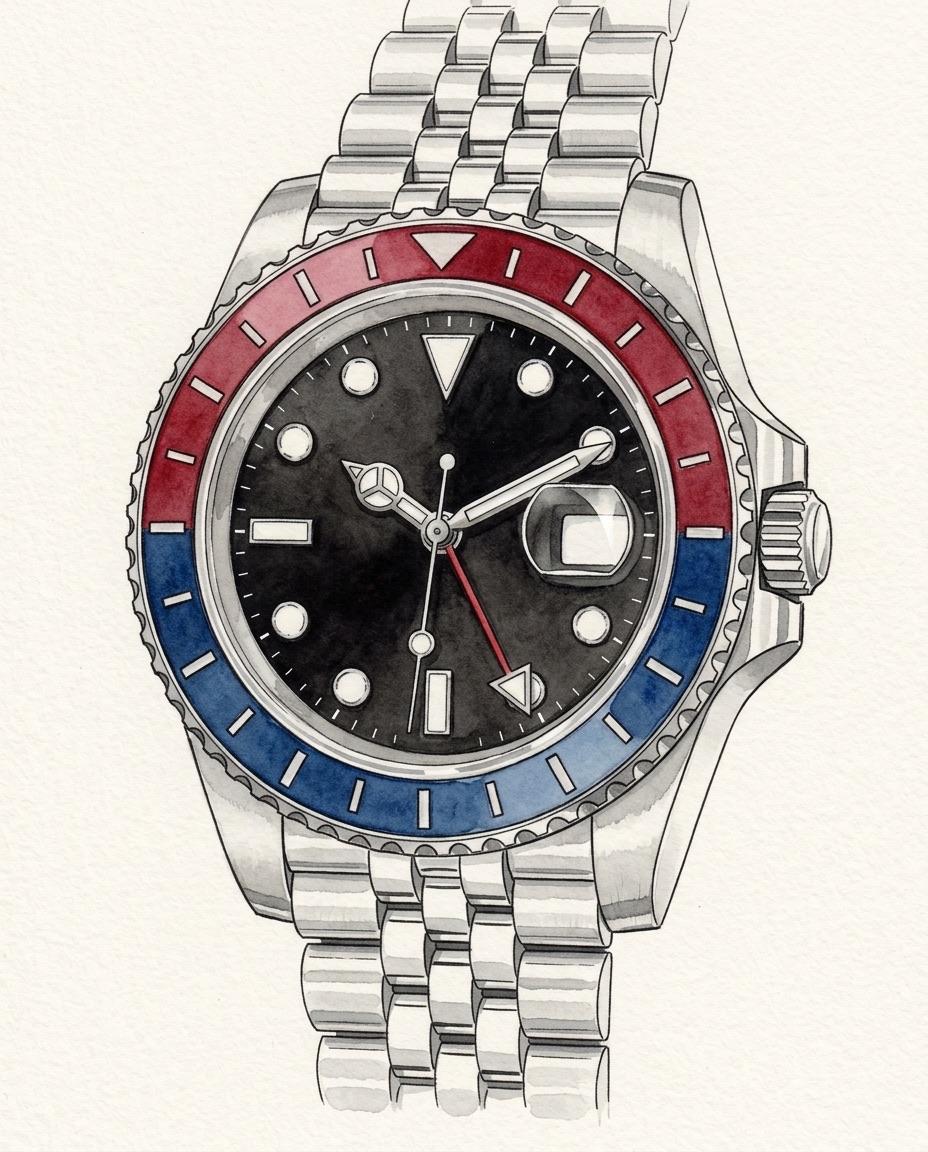
Ref. 126710BLRO is the steel GMT-Master II with the red-and-blue bezel that collectors call the 'Pepsi'. According to Bob's Watches, Rolex has never used the nickname itself, and the suffix BLRO is short for the French bleu and rouge8. The watch arrived at Baselworld in March 2018 and left Rolex's catalogue in April 2026, around Watches and Wonders4,8,11.
Red for day, blue for night
The first GMT-Master, ref. 6542, was developed with Pan American World Airways, better known as Pan Am, for pilots on long-haul routes8,12,13,27. A fourth hand goes round the dial once every 24 hours, and the 24-hour bezel was coloured red for the daytime hours and blue for the night8,13,28. Rolex dates the GMT-Master to 1955, and Bob's Watches dates the 6542 to 1955 too; Sotheby's gives both 1955 and a production start in 1954; see «Where the sources disagree»8,12,27,29.
The bezel's material changed more than its colours: Bakelite on the earliest 6542s, then anodised aluminium from 1959 to 2007, then ceramic8,12. The steel GMT-Master II ref. 16710, made from 1989 to 2007, was the last 'Pepsi' with an aluminium insert, and after it the red-and-blue bezel was missing from steel for eleven years8,12.
Rolex's first two-colour ceramic insert, in blue and black, came in 2013 on the 116710BLNR5,7. Red was harder: Bob's Watches says red pigment is difficult to stabilise at the temperatures ceramic is fired at8. The first red-and-blue Cerachrom insert arrived in 2014, on the white-gold 116719BLRO5,7,12.
What arrived in 2018
At Baselworld 2018 the red-and-blue Cerachrom bezel came to a steel case for the first time, as ref. 126710BLRO; Monochrome published its launch story on 21 March 20184,7,12. The case stayed at 40 mm, with thinner, more tapered lugs, and the bezel insert was the same construction as on the white-gold watch4.
Inside was the new calibre 3285, with about 70 hours of power reserve where the 3186 it replaced had about 48, and Rolex's Chronergy escapement4,7,8.
It came on a five-link Jubilee bracelet, which Rolex says was first made for the Datejust in 19451. Bob's Watches calls it the first time in decades that the five-link bracelet had returned to Rolex's professional line8. The blue-and-black 126710BLNR followed in 2019, also on a Jubilee2,7,13.
In 2021 Rolex added a three-link Oyster bracelet as an option on both, under the same reference number2,5,7. The two versions are told apart by their model numbers: m126710blro-0001 on the Jubilee and m126710blro-0002 on the Oyster1,3. Monochrome reported the Oyster version as EUR 200 cheaper in 2021, at EUR 8,900 against EUR 9,1002.
How it ended
Watches and Wonders opened in Geneva on 14 April 202630. Bob's Watches and Complex both report that the 126710BLRO's page disappeared from rolex.com that day, together with the white-gold 126719BLRO, and that no successor was named8,11. SwissWatchExpo lists both bracelet versions as discontinued10.
Bob's Watches and Complex also report that dealers had been told over the winter that no more deliveries were coming8,11. Wikipedia says the watch was taken off Rolex's and dealers' websites before the fair, and that Rolex did not confirm the discontinuation13.
We could not settle the exact day ourselves. The Internet Archive's last copies of the watch's rolex.com pages with a price are from 10 October 2025 for the US, 9 December 2025 for the German-language site and 12 February 2026 for the international English site, which was still listing it then1,14,15. We found no later copy. On 16 October 2026 both US model pages returned «page not found», and Rolex's GMT-Master II pages for the US, the UK and Germany no longer showed it22,23,31,32,33.
Rolex has given no reason that we could find. Dealers point to the red ceramic: Bob's Watches says the difficult red pigment limited production, and SwissWatchExpo writes of years of speculation about the bezel's production yields8,10. That is their reading, not Rolex's.
What it cost
Rolex no longer lists a price, because it no longer lists the watch22,23. The last list prices we could observe on rolex.com, through the Internet Archive, were USD 11,300 for the Jubilee version in the US on 10 October 2025, GBP 10,050 on Rolex's international English site on 12 February 2026, and EUR 11,250 on its German-language site on 9 December 20251,14,15. The US Oyster version was USD 11,100 on 11 September 20253.
About a year earlier the same pages showed USD 10,900 (7 October 2024), GBP 9,650 (12 March 2025) and EUR 11,150 (10 December 2024), and the US Oyster USD 10,700 (8 November 2024)21,34,35,36. That is a rise of 3.7 per cent in the US for both bracelets and 0.9 per cent in euros, over spans of 10 to 12 months. Sterling depends on the window: the international site still showed GBP 9,650 on 6 September 2025, so the whole rise to GBP 10,050 (4.1 per cent) came between September 2025 and February 2026, while from September 2024 (GBP 9,550) to September 2025 it was 1.0 per cent. The sterling figure therefore covers a later price round than the dollar and euro figures, and the four are not strictly comparable14,37,38.
Other sites report higher US list prices that we could not check on rolex.com; see «Where the sources disagree».
On Chrono24, we can measure asking prices up to February 2026. The median asking price on the first page of Chrono24's 126710BLRO listings was USD 21,900 in September 2024 and USD 22,990 in October 2025, up 5.0 per cent; measured from February 2025 (USD 22,089) to February 2026 (USD 23,200) it was also up 5.0 per cent16,17,19,20. Both windows point the same way. In the first, Rolex's US list price rose 3.7 per cent, so asking prices moved slightly ahead of list1,21; for the second we have no US list price from 2026 to compare.
On every date we checked, the median asking price sat at roughly twice Rolex's US list price for the Jubilee version: between 1.9 and 2.1 times, depending on the date and on which list price applied; for February 2026 we used the last price we observed, from October 20251,16,17,18,19,20,21,39,40,41,42. The last archived copy is from 9 February 2026, so these figures stop before the discontinuation. Asking prices are not sale prices, and the first page mixes new, unworn and pre-owned watches: read them as a direction, not a valuation.
For the months after April, the only figures we found are one dealer's own sales. Bob's Watches reports a median sold price of USD 21,295 for the steel 'Pepsi' between August and October 2025 and USD 25,433 between May and July 2026, up about 19 per cent; comparing all its sales before April 2026 with all those after gives USD 21,854 against USD 25,470, up 16.5 per cent8. These are sale prices, but from a single dealer that also sells the watch.
Buying one pre-owned
Rolex's position is that new watches come only from the jewellers it appoints43, and they no longer have this one to sell8,11. Elsewhere, the checks above are the minimum.
Bob's Watches adds two points. A watch made between 2018 and 2025 should still have its card, tags and box; and about two-thirds of the steel 'Pepsi' watches it sold in the past year were on the Jubilee, so Oyster examples turn up less often8.
Two dates are worth checking on the papers. The watch was presented in March 2018, and the Oyster version arrived in 20212,4. A card dated before those for the version in front of you deserves a question.
Nobody can tell you how many were made. Rolex publishes no production figures by reference, and the analyst estimates that exist cover the whole brand: Morgan Stanley and LuxeConsult put Rolex's 2025 volume at about 1.15 million watches26, and Monochrome notes that such figures are estimates, not numbers provided by the brands25.
The dubious part
Red marks the daytime hours and blue the night, so a pilot over the Atlantic could tell at a glance whether it was day at home8,13. Most owners have a window for that.