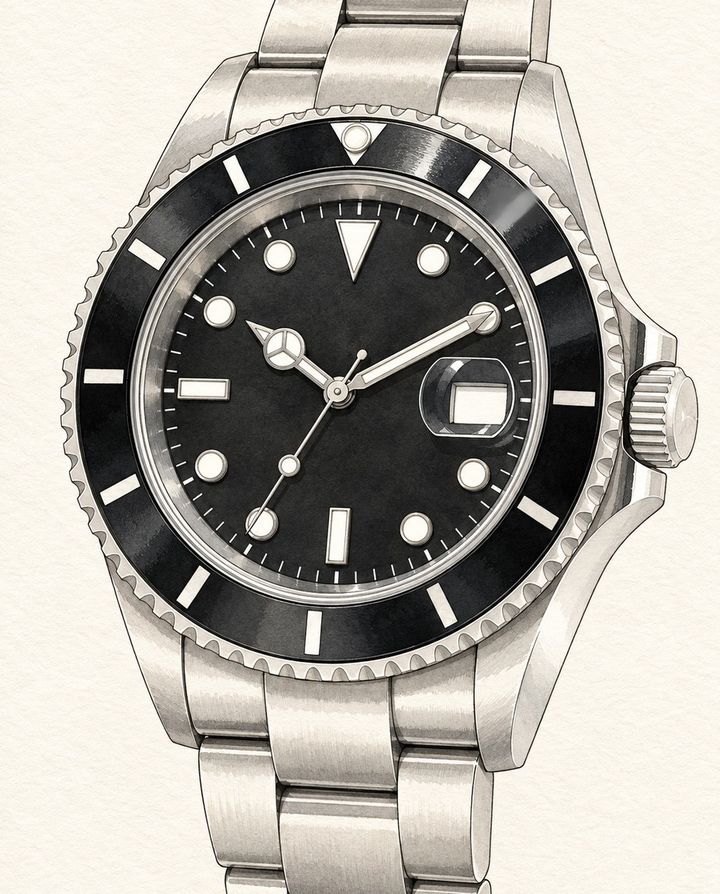
Some watches are made for a job. The Sea-Dweller was made for one that almost nobody has: living for weeks under pressure and coming back to the surface without the watch losing its crystal on the way. Ref. 126600 is its current steel form: 43 mm of Oystersteel, waterproof to 1,220 metres, with a valve in the side to let helium out1,7,11.
It is also the Sea-Dweller that broke a few habits. It grew, it gained a date lens and it put red back on the dial. What follows is what changed, what Rolex changed again on the clasp around 2022, what it costs and how to tell a real one from the rest.
A watch for coming back up
Rolex dates the Sea-Dweller to 1967. It was built for saturation diving, in which divers live for long stretches, often weeks, in a pressurised habitat and breathe a gas mix that is mostly helium7,8,11. Helium atoms are small enough to work their way into a watch case. During decompression the pressure inside the case can stay higher than the pressure around it, and a crystal can pop off8,11. The answer was a one-way valve in the side of the case, which opens by itself when the pressure inside is too high7,11.
According to Wikipedia, Rolex filed its patent for the valve on 6 November 1967, and it was granted on 15 June 19708. Wikipedia and Bob's Watches trace the idea of a one-way valve to Robert A. Barth, a US Navy diver from the SEALAB programme8,20. The French diving company Comex came later. Rolex says Comex professionals then helped it develop the watch further, and it made the partnership formal in 197111.
Rolex rated the first Sea-Dweller to 610 metres. From 1978 it was rated to 1,220 metres, and the standard Sea-Dweller has kept that figure ever since7,11,21.
From the Double Red to the 116600
The first production model, ref. 1665, had two lines of red on its dial, SEA-DWELLER and SUBMARINER 2000, which is why collectors call it the Double Red. A handful of prototypes before it had only the first line, and are known as Single Reds7,8. Ref. 16660 brought the 1,220-metre rating and a sapphire crystal in 19787,8, and ref. 16600 followed in 1988 or 1989 with calibre 31357,8,21.
Then came a gap. The 16600 left the catalogue in 2008 or 2009, and for some five years the only Sea-Dweller in the catalogue was the 44 mm Deepsea, launched in 20086,7,8,20. The 40 mm Sea-Dweller returned in 2014 as ref. 116600, with a ceramic bezel and the Glidelock clasp, and lasted only until 20177,21,22. So the watch the 126600 replaced was the 116600, not the 166004,10,22.
What changed in 2017
Rolex presented the 126600 at Baselworld in March 20174,8. It was fifty years since the first Sea-Dweller, and the press called it the anniversary model. aBlogtoWatch noted that Rolex presented it that way on its stand, but did not put the anniversary in its name4,6,7.
Four things changed. The case grew from 40 to 43 mm and the lugs from 20 to 22 mm4,7,8. The crystal gained a Cyclops lens over the date, the first on any Sea-Dweller4,6,7,21. Rolex told Fratello that such a lens had been technically impossible on a crystal built for these depths; Fratello reported that a thicker crystal solved it6. And the dial got a single line of red, the name SEA-DWELLER, which Rolex describes as a nod to the first model3,14.
The fourth change is inside. Calibre 3235 replaced the 3135, and the power reserve went from about 48 hours4 to about 704,7. It runs at 28,800 vibrations an hour with Rolex's Chronergy escapement and a blue Parachrom hairspring, and Rolex certifies it to within two seconds a day either way after casing3,7. In practice: take it off on Friday evening and it is still running on Monday morning.
The calibre was not new, though. aBlogtoWatch called it the same movement as the Datejust 41's, and Grail Watch dates the 3235's first appearance to late 20154,23. What was new was finding it in a Sea-Dweller.
The quiet change: -0001 and -0002
The 2017 watch, m126600-0001, came with two ways to lengthen the bracelet. The Glidelock in the clasp adjusts it by about 20 mm in steps of about 2 mm, without tools. The Fliplock, a folding link, added another 26 mm. Together, Rolex said, they let the watch go over a diving suit up to 7 mm thick4,14.
Rolex still listed the Fliplock for -0001 in November 2021. By May 2022 its page showed -0002, with the Oysterlock clasp and Glidelock only2,15. Nothing else in Rolex's specifications differs between the two2,15, and -0002 is the version Rolex lists today1.
Collectors also split the early watches by dial. The first dials have no small Rolex crown between SWISS and MADE at six o'clock; dealers call them Mk1 and date the crown's arrival to 201817,18. Mk1 is a trade name, not a reference: both dials belong to the same 126600.
Between the Submariner and the Deepsea
At 43 mm and 1,220 metres the Sea-Dweller sits between the Submariner, now 41 mm and waterproof to 300 metres, and the Deepsea, 44 mm and waterproof to 3,900 metres1,14,15,24. The Deepsea moved to calibre 3235 with ref. 126660 in 2018 and became ref. 136660 in 2022, which, according to Wikipedia, also dropped the Fliplock7,8,21.
In 2019 Rolex added a two-tone sister, ref. 126603, with an 18 ct yellow gold bezel, crown and centre links on the same 43 mm case. It was the first time gold appeared on a Sea-Dweller8,25,26.
Rolex publishes no thickness for the 126600; Wikipedia and Bob's Watches give about 15.2 mm, and aBlogtoWatch put the height down to the depth rating4,8,20. It was never meant to slide under a cuff.
What it costs
On 29 October 2026 Rolex's recommended price for the 126600 was USD 14,550 in the US, GBP 12,150 in the UK and EUR 13,950 in Germany1,12,13. About a year earlier it was USD 13,750, GBP 11,750 and EUR 13,65016,27,28. That is a rise of 5.8, 3.4 and 2.2 per cent.
Over a longer window the US price went from USD 13,250 in October 2023 to USD 14,550, a rise of 9.8 per cent in three years1,29. The German-language price went from EUR 13,550 in October 2024 to EUR 13,950, or 3.0 per cent in two years13,30. Both windows point the same way, and the US price has risen fastest.
We do not show third-party market prices.
Buying one pre-owned
Rolex's position is simple: buy from a jeweller in Rolex's own retail network, which Rolex says guarantees authenticity31. Away from the retailer, the checks above are the minimum. Look for the lens over the date, the single red line, the valve in the left flank and a clasp that matches the variant.
Nobody outside Rolex can tell you how many 126600s exist. The only production figure we found covers nearly 4 million Submariner and Sea-Dweller watches made from 1953 to 2020, all references together; Bloomberg took it from a book Rolex approved19. Morgan Stanley and LuxeConsult estimate that Rolex sold about 1.15 million watches in 202532, and say their figures were not provided by the brands33.
The dubious part
The helium escape valve exists so that a watch can come home from weeks in a pressurised habitat. Most 126600s will only ever meet helium in a party balloon. The valve stays ready, just in case.