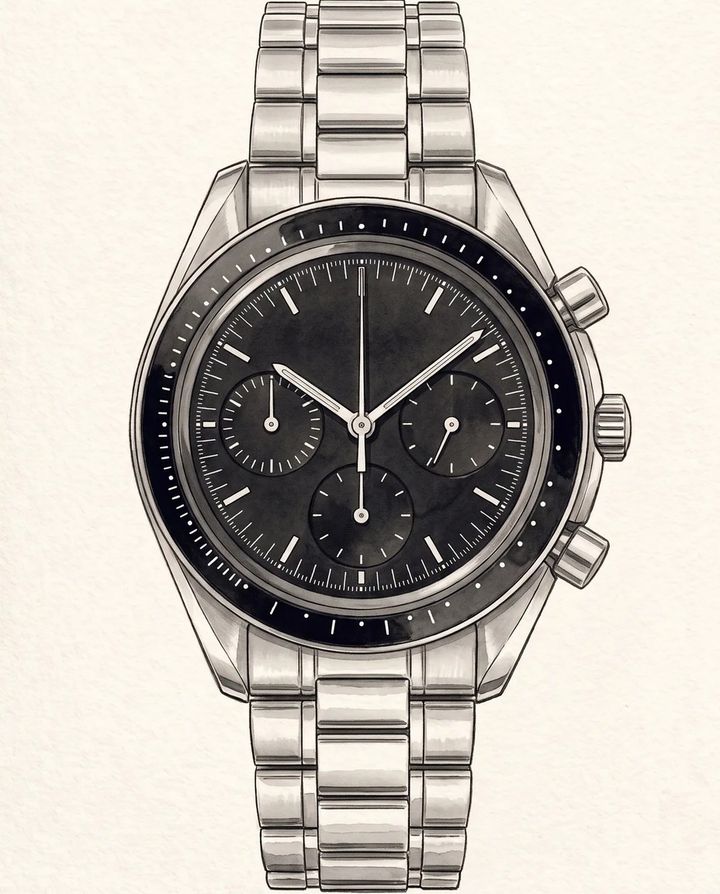
Why it is called «Reduced»
Omega's name for the watch was Speedmaster Automatic, and that is what the dial says1,2,3. Fratello's Robert-Jan Broer, who began collecting Speedmasters in the mid-1990s, recalls that he and many others then saw it as the Moonwatch's kid brother2. Everyone agrees the name is about size; not everyone agrees it stops there. Worn & Wound says it is called Reduced because of its dimensions5. Fratello's Rob Nudds says the name refers to the width and also to the movement, a budget alternative to the calibres in the Speedmaster Professional of the day4. Bob's Watches says Omega sold it as the smaller and cheaper Speedmaster, and SwissWatchExpo says it was meant for smaller wrists and everyday wear1,9.
How much smaller is less than the name suggests. The listed 39 mm comes to 38.5 mm in Fratello's and Worn & Wound's figures, against the Moonwatch's 42 mm1,4,5. Nudds wrote that it wears smaller than a regular Speedmaster, but is not as tiny as the name implies4.
How much cheaper is in the table further down. Near the end of production, the Reduced's US retail price was USD 550 below the Moonwatch's, about 16 per cent6,8.
The movement: from 1140 to 3220
Fratello describes the first calibre, the 1140, as ETA's 2890-A2, the no-date version of the 2892-A2, with a chronograph module that Dubois-Dépraz catalogued as its calibre 20202. It is a modular chronograph: the pushers work a separate mechanism on top of the base movement4. Worn & Wound gives the combined movement a thickness of 6.5 mm, against close to 8 mm for a Valjoux 7750, and notes that because the chronograph's seconds, minutes and hours are all driven from the base, the minute counter creeps forward instead of jumping5.
Omega changed the calibre number three times. The sources agree on the order and disagree on the base:
Bob's Watches says that whatever the number, the movement is virtually the same1. Fratello's Broer wrote in 2016 that he did not know what the change from 1140 to 3220 was about2. Neither do we; we found no Omega document that says.
The references
Years are the dealers' and collectors', not Omega's. The Reduced case was also used for date, day-date, perpetual calendar and moonphase models, and for gold and two-tone versions1,2. They are other watches, and not on this page.
Reduced or Moonwatch
The Moonwatch is the watch with the history; our Moonwatch page has it, generation by generation. The Reduced is the one that winds itself. In 2016 Broer put the difference plainly: the Reduced did not need winding every other day2. The price of that convenience comes later, at the service, as Fratello noted in 2026: service costs for this movement can be somewhat higher than for the Moonwatch's hand-wound 1861 or a 7750-based automatic10.
How it ended, and the 38
Fratello's Broer says the Reduced was phased out quickly once automatic Speedmasters with Omega's co-axial movements, like the Broad Arrow, arrived2. Monochrome says that in 2010 the model changed direction: it became a 38 mm watch with calibre 3304, a date and, overall, a more feminine design7.
In March 2026 Broer wrote: «It still baffles me, though, that the brand hasn’t released a new or modern version of the Speedmaster Reduced ref. 3510.50.»10 In August 2026 Omega released a black, steel, no-date Speedmaster 38 mm, ref. 324.30.38.50.01.002, which Monochrome describes as a return of the original recipe of 19887. It is not a Reduced. Its integrated calibre 3332 puts crown and pushers on one level, it is 14.75 mm thick, water-resistant to 100 metres, and Monochrome gives its price as EUR 6,400 including tax, or CHF 5,100 excluding tax7. Fratello's podcast discussed in October 2026 whether it carries the Reduced's spirit forward; we have read the summary, not heard the answer11.
What it cost new
We found no Omega price list for 1988. The earliest dated retail price we could read is from 2009, from archived pages of the US dealer Prestige Time, which listed Omega's retail price beside its own6,8.
We do not show third-party market prices, so there is no pre-owned figure on this page. The current Prestige Time page lists the 3539.50's retail price as USD 2,800, USD 100 less than its own page said in 20096,12; we use the 2009 figure, read while the watch was still in the catalogue.
Buying one pre-owned
Service is the real price. Worn & Wound warns that modular chronographs can be tricky to service and that not every watchmaker wants to5. Fratello's podcast says the construction made servicing more involved for some watchmakers11. 5D Watches goes further: most independent watchmakers will service the ETA base but not open the module, and the usual answer is a movement exchange through Omega at USD 1,500 to 1,800 in the US in 20263. Fratello's Rob Nudds, who worked on these at the bench for Omega, is milder: the module takes more patience, but any decent watchmaker with Omega accreditation should manage it4. Ask for the paperwork from the last service.
The bracelet is the weak part. Worn & Wound calls the clasp cheap-feeling and expects rattle on a watch that has been worn for a decade or two5. 5D Watches says the first bracelets stretched3. The 18 mm lugs take most straps, and Worn & Wound calls the watch a strap monster5.
Japan has many of them. Fratello said in 2020 that a great many of the best-preserved examples come from Japan, presumably because the model was once popular there, and that import duties from Japan can be high4.
Hesalite or sapphire. The 3510.50 has Hesalite; the 3539.50 has sapphire1,3. The choice is between the softer look and the harder glass.
Keep it dry. Thirty metres on the 3510.50, which Worn & Wound calls washing-hands territory5. For an Omega that likes water, see our Seamaster Diver 300M page. The watch index has the rest, and how we verify explains how we check our own numbers.
We found no production figures from Omega for the Reduced. The only figures we found are 5D Watches': 1,000 pieces of the 3510.82 for Japan, and 10,000 numbered pieces of the 3517.30, a Racing edition released after Schumacher's 2000 championship that is not on this page3.
The dubious part
Omega's name for it was Speedmaster Automatic; Reduced is what collectors called it2,3, for a watch listed 3 mm narrower than the Moonwatch and, in early 2009, about 16 per cent cheaper1,6,8. What it reduced most was the winding.