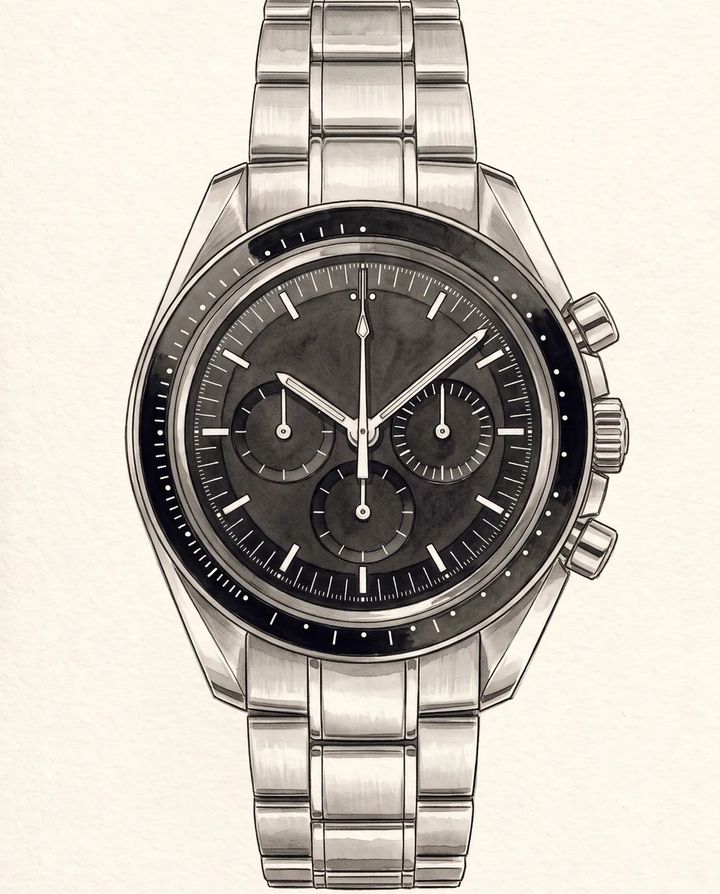
Ref. 310.30.42.50.01.001 · since January 2021
Omega · The Speedmaster, model by model · catalogued from 31 sources
Compiled by Anton Hoelstad · Updated
Omega made the Speedmaster in 1957 to time racing laps, and NASA took it to the Moon. On most wrists since, its chronograph has timed the pasta.
The Omega Speedmaster is the chronograph line Omega introduced in 1957 for sport and racing1,10. NASA qualified it for its astronauts in 1965, and Buzz Aldrin wore one on the Moon on 21 July 19693,14,15,16. This site covers two Speedmasters: the hand-wound, 42 mm Speedmaster Professional, which collectors and Omega call the Moonwatch, since January 2021 ref. 310.30.42.50.01.001 with calibre 38614,9,17; and the Speedmaster Reduced, the smaller automatic made from 1988 until about 2009, ref. 3510.50 in black steel on a bracelet5,6,7.
Four generations of Moonwatch calibre: the 321 until 1968, the 861 from 1968, the 1861 (the 1863 in the sapphire versions) from about 1997 and the co-axial 3861 since January 20212,9,10,11,17.
The shape dates from the 105.012 of 1964, the first Speedmaster with Professional on the dial and an asymmetrical 42 mm case1,10,17.
The Reduced is not a smaller Moonwatch: it has an ETA automatic base with a chronograph module, and says Automatic on the dial5,6,18.
Ref. 310.30.42.50.01.001 · since January 2021
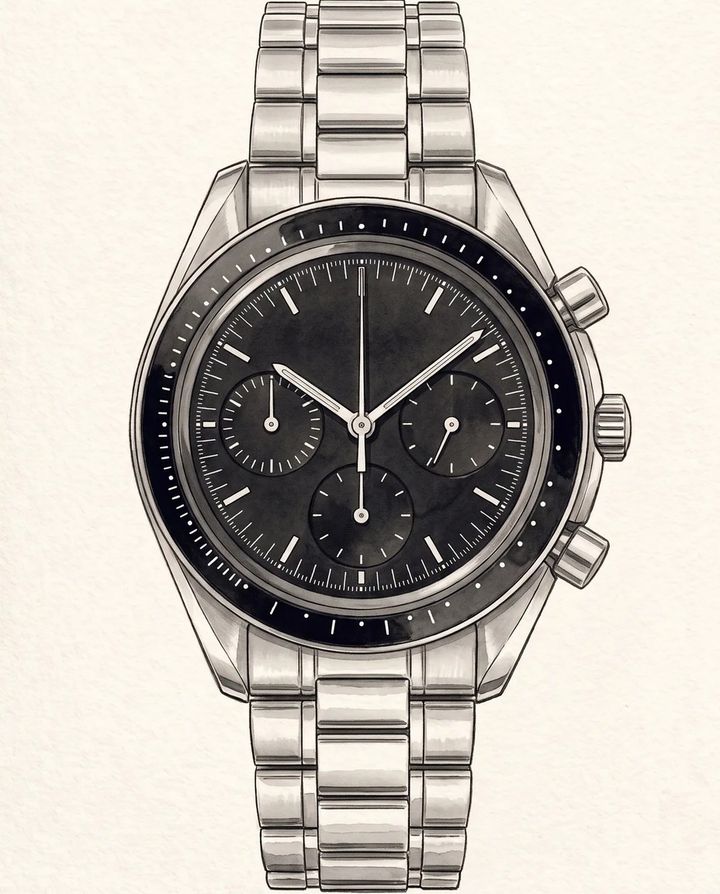
Ref. 3510.50 · 1988 to 2009 or 2010, depending on the source
The first Speedmaster, the CK 2915 of 1957, arrived alongside the Seamaster 300 and the Railmaster10, and was the first chronograph with its tachymeter scale on the bezel1,9,10.
In 1964 NASA asked for a durable chronograph for the Gemini and Apollo crews. Three watches went through its eleven tests, and the Speedmaster 105.003 was the one that passed3. NASA qualified it in 1965; the exact day is disputed, and the Smithsonian dates NASA's choice to 19643,14,19.
The 105.012 of 1964 was the first Speedmaster with Professional on the dial and an asymmetrical 42 mm case that guards the crown and pushers1,10. In 1966 it became the 145.012, with taller pusher caps1,10. Wikipedia names these two as the references worn on the Moon; Fratello adds Gene Cernan's older 105.0031,2,3. On Apollo 11 Neil Armstrong left his in the lunar module as a backup, and Aldrin wore his1,16. Speedmasters went on all six lunar landings10,20.
In 1968 the 145.022 brought calibre 861, which replaced the 321's column wheel with a cam and raised the beat from 18,000 to 21,600 vibrations per hour1,2. It never went to the Moon2. NASA qualified the 861 version again in 1978 for the Space Shuttle, and in 1988 a new numbering made the watch the 3590.502,10,11.
In about 1997 the movement became the rhodium-plated 1861, in the 3570.50, with the better-finished 1863 in the sapphire versions10,11,17. In 2014 the 3570.50 became the 311.30.42.30.01.005, essentially the same watch11,17.
In January 2021 the 310.30.42.50.01.001 brought calibre 3861, with a co-axial escapement and a Master Chronometer certificate, and gave the dial its step back and the bezel its dot over 909,17,21. Omega also reissued the 321 in 2019, in a separate Speedmaster1,11. Our Moonwatch page shows how to tell the generations since 1968 apart.
From 1988 Omega also made a smaller Speedmaster that winds itself. Omega called it the Speedmaster Automatic; «Reduced» is the collectors' name5,6,18. Inside is an ETA automatic base with a Dubois-Dépraz chronograph module, which Omega numbered 1140, then 1141, 1143 and 32205,6,18.
The black steel watch on a bracelet is the 3510.50 with Hesalite, and from 2006 the 3539.50 with sapphire5,6. Production ended in 2009 or 2010, depending on the source5,6,7,8. Our Reduced page has the black and coloured-dial references and all four accounts of the base movement.
Omega's black no-date Speedmaster 38 of August 2026, ref. 324.30.38.50.01.002, recalls the 1988 recipe, by Monochrome's account, but it is not a Reduced: its integrated calibre 3332 puts crown and pushers on one level8.
The dials are close to mirror images, and the cases differ by about 3 mm; the table below has the rest4,5,6,22. The real difference is the movement. In 2016 Fratello's Robert-Jan Broer put the Reduced's case simply: it did not need winding every other day18. The cost comes at the service, which Fratello said in 2026 can be somewhat higher than for the hand-wound 186123.
In early 2009 a US dealer listed Omega's retail price for the Reduced 3539.50 at USD 2,900 and for the Moonwatch 3570.50 at USD 3,450, a gap of about 16 per cent24,25.
The 3861 added 15,000 gauss of magnetic resistance, 50 hours of reserve against about 48, and a seconds hand that stops while you set the time; the 1861 had no chronometer certificate9,17. Monochrome put the 3861's launch price about EUR 1,300 above the reference it replaced9.
The Hesalite version has a solid back with the NASA engravings and a printed logo; the sapphire version has a display back, an applied logo and polished centre links. The movement is the same17. Fratello's Broer would take the Hesalite; Monochrome's reviewer leaned towards sapphire for daily wear11,17.
The prices in the table below come from our two reference pages, with their dates and labels. We show no pre-owned prices. From January 2021 to September 2026 Omega's US list price for the Hesalite Moonwatch rose from USD 6,300 to USD 7,800, about 24 per cent12,26.
If you want the Moonwatch as Omega makes it now: the 310.30.42.50.01.001 with Hesalite, or the .002 with sapphire front and back4,20. Ask for the Master Chronometer card; Omega lets the owner look up the test results by its number27,28.
If you want the 1861: the 3570.50 and the 311.30.42.30.01.005 are essentially the same watch, so choose on condition. Broer says a claim of a recent service without paperwork should be treated as no service11. For a 145.022, Fratello says the case-back suffix dates the back, not the watch, and that many bezels were swapped years ago2.
If you want a Speedmaster that winds itself and sits a little smaller: the Reduced 3510.50 with Hesalite or the 3539.50 with sapphire5,6. Ask for the paperwork from the last service first. 5D Watches says most independent watchmakers will not open the module; Fratello's Rob Nudds, who worked on them at Omega's bench, says a decent watchmaker with Omega accreditation should manage it6,7. The 3510.50 is rated to 30 metres5,22; for an Omega that likes water, see our Seamaster hub.
None of the checks on our reference pages proves a watch genuine; they are the questions to ask before you pay28,29.
Speedmasters went on all six Moon landings10,20. The first Speedmaster Professional calibre that stops its seconds hand while you set the time is the 3861, which reached the Moonwatch in January 20219,17. It reached the Moon some fifty years before it learned to stand still.
| Reference | Line | Years | How to tell it | Calibre |
|---|---|---|---|---|
| 105.012 | Professional | 1964–196810 | Steel, 42 mm, the first asymmetrical case; Professional on the dial; Hesalite1,10 | 3211,10 |
| 145.012 | Professional | 1966–19681,2 | As the 105.012, with taller pusher caps screwed into the case10 | 3211,2 |
| 145.022 (-68 to -78), then 145.0022 | Professional | 1968–19882,11 | Tritium dial with T marks; step dial on -69 and -71, flat from -74; dot over 90 only on -68 and some -692,10 | 8612 |
| 3590.50 | Professional | 1988–19962,11 | Omega's new product code; tritium; bracelet 14792,10 | 8612 |
| 3570.50 (Hesalite) · 3573.50 (sapphire, from 2002 or 2003) | Professional | 1997–201411 | Flat dial, Super-LumiNova from about 1997, rhodium-plated movement; bracelet with friction pins10,11 | 1861 · 186311,17 |
| 311.30.42.30.01.005 (Hesalite) · .006 (sapphire) | Professional | 2014–202111 | Same watch; screws in the bracelet links and a large box11 | 1861 · 186311 |
| 310.30.42.50.01.001 (Hesalite) · .002 (sapphire) | Professional | 2021–present9 | Step dial, dot over 90, chronograph track in thirds, hacking seconds, tapered bracelet9,17 | 38619 |
| ST 175.0032 (strap) · ST 375.0032 (bracelet) | Reduced | from 19885,6 | The first codes; the same watch became the 3510.505,6 | 11405,6 |
| 3510.50 (bracelet) · 3810.50 (strap) | Reduced | 1988–20066 | Listed at 39 mm; Hesalite, black dial, black aluminium bezel, Automatic on the dial5,6,22 | 1140, later 1141, 1143 and 32205,6 |
| 3510.61 red · 3510.12 yellow · 3510.81 blue | Reduced | 1996–19996 | Coloured «Schumacher» dials with a chequered chapter ring6 | 11416 |
| 3510.82 | Reduced | early 2000s6 | Blue dial for Japan6,18 | not stated |
| 3539.50 | Reduced | 2006–20095,6 | Sapphire crystal and a slightly redesigned dial5 | 322024 |
These are the references on our two Speedmaster pages and the ones they descend from, not the whole Speedmaster line: the earlier Speedmasters, gold, limited and other editions are left out. Years are the dealers' and collectors', not Omega's, and watches made around a change can mix both rows. The years of the 105.012 and 145.012 overlap; see «Where the sources disagree». The two reference pages list further disagreements, over the Moonwatch's case-back engravings and thickness, and the Reduced's water resistance, bezel and price.
| Moonwatch 310.30.42.50.01.001 | Reduced 3510.50 | |
|---|---|---|
| Made | since January 20219 | 1988–2006; the Reduced line until about 20095,6 |
| Case | 42 mm, 47.5 mm lug to lug4,17 | listed at 39 mm, 38.5 mm by Fratello and Worn & Wound; 45 mm lug to lug by their figures, about 44 mm by 5D Watches5,6,7,22 |
| Thickness | 13.54 mm, Omega's current figure4 | just under 12 mm22 |
| Lug width | 20 mm4,17 | 18 mm22 |
| Winding | by hand4 | automatic5 |
| Chronograph | integrated, pushers level with the crown7,17 | module on an ETA base, pushers above the crown18,22 |
| Small seconds | at 96 | at 322 |
| Dial text | Professional6 | Automatic5 |
| Power reserve | 50 hours4,17 | about 40 hours5 |
| Water resistance | 50 metres4 | 30 metres5,22 |
The current Moonwatch with Hesalite against the Reduced with Hesalite. Omega's US site listed the Moonwatch at 13.2 mm in 2023 and 2024, and the 3539.50's water resistance is disputed; both are on the reference pages.
| Date | Watch | Price | What it is | Source |
|---|---|---|---|---|
| February 2009 | Moonwatch 3570.50 | USD 3,450 | retail price, as listed by a US dealer | Prestige Time, archived25 |
| March 2009 | Reduced 3539.50 | USD 2,900 | retail price, as listed by a US dealer | Prestige Time, archived24 |
| Before January 2021 | Moonwatch 311.30.42.30.01.005 | just under EUR 5,000 | last list price, by Fratello's account | Fratello11 |
| January 2021, at launch | Moonwatch .001 · .002 | EUR 6,200 · EUR 7,000 | list price at launch | Monochrome9 |
| January and July 2021 | Moonwatch .001 · .002 | USD 6,300 · USD 7,150 | Omega's US list price | omegawatches.com, archived26,30 |
| March 2025 | Moonwatch .001 · .002 | EUR 7,700 · EUR 8,900 | list price | Fratello11 |
| September 2026 | Moonwatch .001 · .002 | USD 7,800 · USD 9,000 | Omega's US list price | omegawatches.com, archived12,13 |
| August 2026, at launch | Speedmaster 38 no-date, 324.30.38.50.01.002 (not a Reduced) | EUR 6,400 | retail price including tax | Monochrome8 |
Every price here is reused from the Moonwatch and Reduced pages with its date and label; only the differences in the text are ours. Archived dates are the days a copy shows the price, not the days it changed. No pre-owned prices.
Should you buy one? If you enjoy winding a watch, the Moonwatch. If you enjoy the idea of the Moonwatch more than the winding, the Reduced.
The house rules · every fact sourced, every disagreement shownWhich Speedmasters were worn on the Moon. Wikipedia and Fratello's buying guide name the 105.012 and 145.0121,2. Fratello's NASA article adds Gene Cernan's 105.003, worn on Apollo 173. We give all three, as our Moonwatch page does.
When NASA qualified it. Omega says 1 March 196514. Fratello says the tests ended on 1 March and the qualification came on 1 June3. The Smithsonian says NASA chose the Speedmaster in 196419. We say 1965, as the case back does17.
What Aldrin wore. Wikipedia says a 105.012, sometimes misreported as a 145.012, and Monochrome also says 105.0121,10. NASA's Apollo Lunar Surface Journal gives no reference16. We say 105.012.
When the 105.012 became the 145.012. Wikipedia says 19661. Monochrome dates the last 105.012, the -66, to 1967–196810, and Fratello says the 321 was used until 19682. We let the two overlap and end both in 1968.
When the 1861 arrived. Fratello's buying guide says 1997, after the 861 ended in 1996, and its 145.022 guide says 1996/1997; Monochrome gives 1996 or 1997 in different articles2,9,10,11,17. We say about 1997.
When the Reduced ended. Bob's Watches and 5D Watches say 2009; Monochrome says 2010, and Fratello 2009 or 20105,6,7,8. We say about 2009.
The Reduced's base movement. Fratello and Worn & Wound say ETA 2890-A2, Bob's Watches 2892-A2, and 5D Watches one then the other; SwissWatchExpo says Valjoux 7750, which no other source supports5,6,18,22,31. We say ETA 2890 or 2892, the same family.