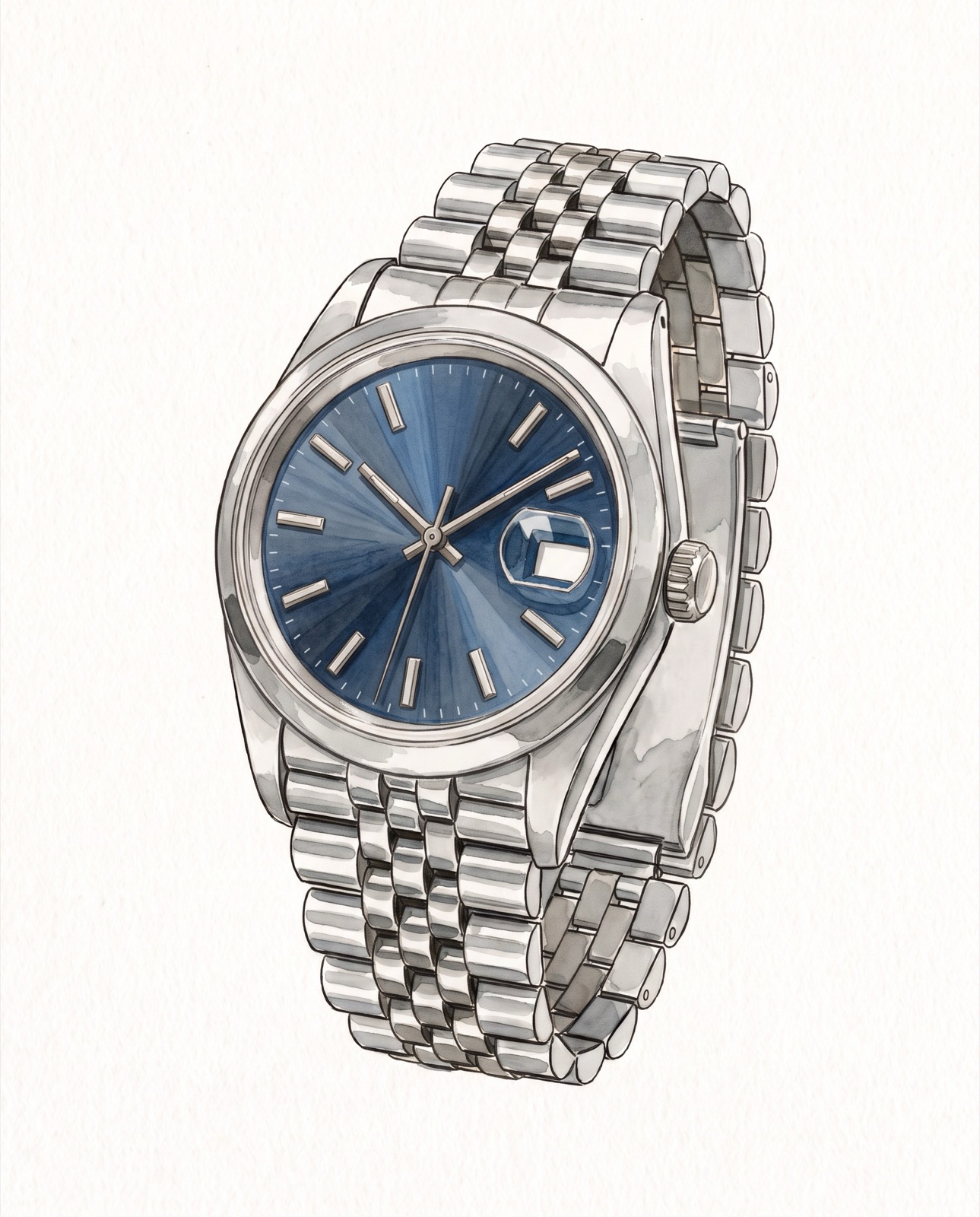
Most Datejusts make some noise about themselves. A fluted gold bezel, a two-tone bracelet, something that catches the light across a restaurant. The 126300 has none of that. It is 41 mm of Oystersteel with a smooth, polished bezel, and the choice of an Oyster or a Jubilee bracelet1,8.
With a flat bezel, the case and the bracelet are entirely steel, as Monochrome put it in its 2017 hands-on3. Bob's Watches calls it the full stainless steel version of the Datejust 412. For a good many buyers that is exactly the point. What follows is where it came from, what changed, what it costs and how to tell a real one from the rest.
From the Datejust II to the Datejust 41
The Datejust arrived in 1945, for Rolex's fortieth anniversary, as ref. 44677,30. By Rolex's own account it was the first self-winding chronometer wristwatch to show the date in a window on the dial30,31. The Jubilee bracelet was made for that launch, and Rolex still says so on the 126300's own page1,32.
For more than six decades the men's Datejust came in one size, 36 mm3,16. That changed in 2009 with the Datejust II, a 41 mm version3,7,24. Its all-steel reference, with a smooth bezel, was the 11630010,24. It ran on calibre 313616,24 and, according to WatchGuys and Bob's Watches, came only on the Oyster bracelet2,16. Watches.co.uk says a Jubilee was offered too7.
The Datejust II was not universally loved. Monochrome called it too bulky for some collectors, with large indexes and a thick bezel3, and Fratello thought its proportions 'a tad bit off'9. At Baselworld 2016 Rolex replaced it with the Datejust 41, first in two-tone Rolesor3,21. The steel versions followed at Baselworld 2017: the 126300 with its smooth bezel, and the 126334 with a fluted white gold one2,3,9. Rolex's own website that summer filed the 126300 under 'New Datejust 41'33.
What changed against the 116300
The diameter stayed at 41 mm2,10. Everything around it got leaner. The Datejust 41 has a slimmer middle case, a thinner bezel and more tapered lugs than the Datejust II, so it wears smaller than the number suggests2,3,9.
The second change is the bracelet. The 116300 came on an Oyster only; the 126300 can be had on a Jubilee too2,3,16. Both bracelets close with a folding Oysterclasp and the 5 mm Easylink extension1,8. Easylink itself was not new: Rolex's 2013 page for the 116300 already lists it24.
The third change is inside. Calibre 3235 replaced the 313616,21. It runs at 28,800 vibrations an hour with Rolex's Chronergy escapement and a blue Parachrom hairspring, and it holds about 70 hours of power reserve1,6. WatchGuys puts the 3136 at 48 hours16. In practice: take it off on Friday evening and it is still running on Monday morning.
The movement was not new to the 126300 either. Calibre 3235 first appeared in 2015, in the Pearlmaster 396,21, and the Datejust 41 has used it since 20166,7. Rolex certifies it as a Superlative Chronometer, to within two seconds a day either way after casing1,7, a standard Rolex redefined in 201534.
Rolex's name for the steel has changed too. Rolex's pages for the 116300 in 2013 and the 126300 in 2017 call the case material 904L steel24,33; today's calls it Oystersteel, of the 904L family1.
Smooth against fluted
The 126300 and the 126334 share the 41 mm Oystersteel case, the calibre and the bracelets. The difference is the bezel3,23. Rolex makes its fluted bezels only in 18 ct gold or platinum, so a fluted steel Datejust means a white gold bezel, a combination known as white Rolesor3,35. The smooth bezel keeps the 126300 all steel.
In Rolex's specification the bezel is the only difference. On 11 October 2026, Rolex's US site asked USD 8,950 for a 126300 on an Oyster with a silver dial and USD 11,650 for the same configuration as a 126334: USD 2,700, or about 30 per cent, more8,15.
Rolex says the fluted bezel now exists to reflect light35. The smooth one is polished, and polish shows wear. Bob's Watches warns that the Datejust 41's polished bezels and polished Jubilee centre links pick up fine scratches from daily desk contact, and that light scratches are removed at a service21.
Dials and bracelets
We could not read Rolex's live catalogue for this page: rolex.com refused our requests for the 126300's pages on 14 October 2026. What follows comes from archived copies of Rolex's own product pages from January 2025 to October 202620.
In that period Rolex showed the 126300 with baton hour markers on bright blue, silver, white, slate, bright black and mint green dials, and with Roman numerals on white, azzurro blue and bright blue dials and on a slate dial with a baton at nine o'clock20. Rolex calls that last one slate. Collectors call it the Wimbledon dial: slate with green-outlined Roman numerals, which 5D Watches describes as a tribute to Rolex's role as timekeeper of the Wimbledon Championships2,21,22. The baton markers carry Chromalight luminescence1,2. The bright blue Roman dial first appears in the archive in April 202620.
The dial does not change the price. In all 13 archived US copies from 2026 we read, which between them cover every dial above on at least one bracelet, an Oyster cost USD 8,950 and a Jubilee USD 9,150, whatever the dial20. Bob's Watches described the same rule in 20212. The Jubilee costs USD 200 more in the US, GBP 150 more in the UK and EUR 200 more in Germany1,8,11,12,13,14.
The Oyster is ref. 72610 and the Jubilee ref. 62610, both 21 mm wide1,8.
What it costs
On 11 October 2026, in the archived copies of rolex.com, Rolex's recommended price for the 126300 on an Oyster was USD 8,950 in the US, GBP 7,450 in the UK and EUR 8,600 in Germany8,11,13. Between September and December 2025 the same bracelet cost USD 8,500, GBP 7,200 and EUR 8,40017,27,36,37. That is a rise of 5.3, 3.5 and 2.4 per cent. The 2025 pound and euro figures come from Rolex's international English site and its German-language site, neither of which named a country.
For comparison, Rolex's US price for the two-tone Datejust 36 ref. 126233 on a Jubilee rose 10.4 per cent over roughly the same twelve months18,19. The steel watch moved about half as much.
At its launch in 2017, Monochrome reported a starting price of EUR 6,750 on an Oyster and EUR 6,850 on a Jubilee3. Fratello put the start at EUR 6,7009. Neither named the country, so we do not set them against today's German price.
Buying one second-hand
Second-hand, we can only measure asking prices. The median asking price on the first page of Chrono24 listings rose from about USD 10,200 in March 2025 to USD 11,295 in October 2025, about 10.7 per cent25,38. Over a similar stretch Rolex's own US price for the Jubilee went from USD 8,400 to USD 8,700, about 3.6 per cent26,39. In October 2025 the median asking price sat about 30 per cent above the Jubilee's list price, which Rolex's US site showed as USD 8,700 in both July and November 2025, and about 33 per cent above the Oyster's USD 8,50017,26,27,40.
Asking prices are not sale prices. That first page mixes new and used watches, both bracelets and at least one diamond-dial watch, which is not a dial Rolex lists for this reference20,25, so read it as a direction, not a valuation.
Nobody can tell you how many 126300s exist. Rolex publishes no production figures for any model. The only numbers are analyst estimates: Morgan Stanley and LuxeConsult estimate that Rolex sold about 1.15 million watches in 202529, and say their figures were not provided by the brands28. That covers every model, and none of it is broken down by reference.
The dubious part
The smooth-bezel Datejust is for the man who wants a Rolex nobody will notice. He then spends the evening adjusting his cuff.